2024

Common clubmoss (Lycopodium clavatum)

With their evergreen foliage, yellow spore-bearing cones, and ropey stems, club-mosses or lycopods (Lycopodium species, in the broad sense) are nearly perfect for shaping Christmas wreaths. Actually, they may be too perfect for their own good. In the 19th and early 20th centuries, club-mosses were often over-harvested for their use as holiday greens. This, in combination […]
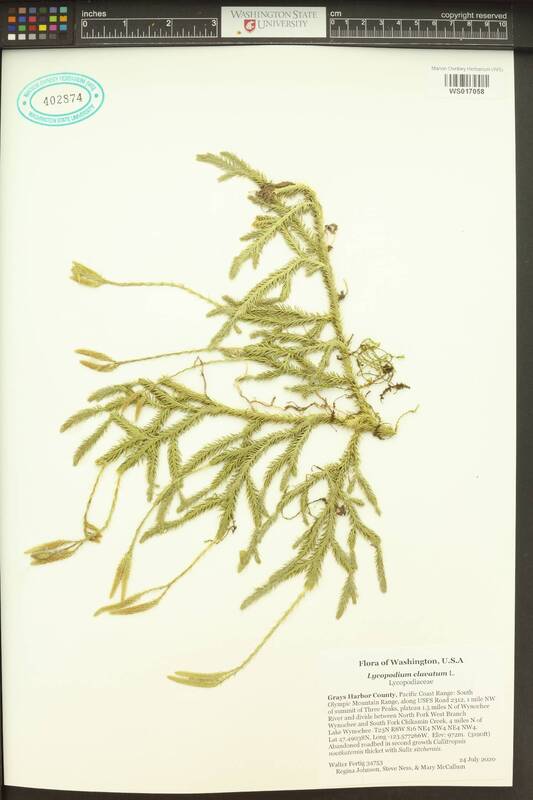
Common clubmoss (Lycopodium clavatum).

Thompson’s peteria (Peteria thompsoniae)

One of the mysteries of plant evolution is why some genera are incredibly species rich, while closely related ones contain just a few species. A case in point is Astragalus (commonly known as milkvetch or locoweed) which contains over 3200 species on every continent except Australia, and its cousin Peteria (sometimes called spiny milkvetch) with just 4 species in […]

Thompson’s peteria (Peteria thompsoniae).

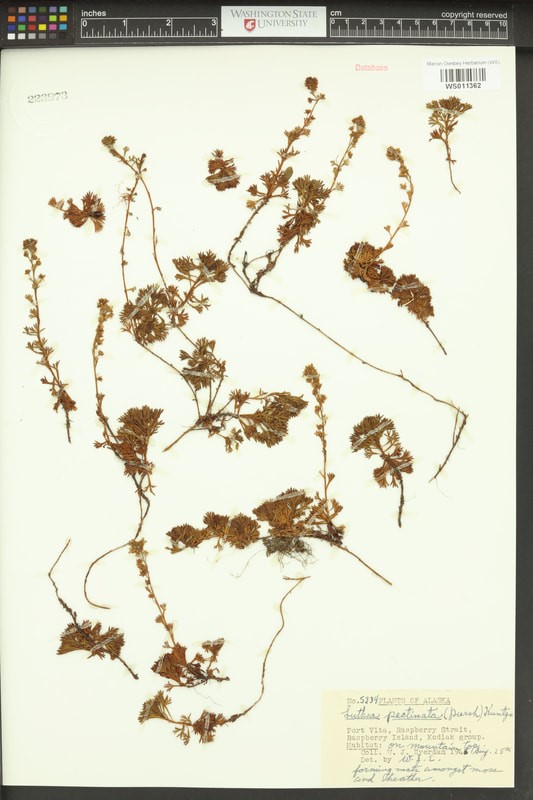
Partridge-foot (Luetkea pectinata)

Partridge-foot gets its common name from its distinctive slender, wedge-shaped leaves which branch in threes, like the front toes of the eponymous game bird. The leaves may form dense mats, or be more widely spaced along a woody rhizome. These white-flowered plants are only 4-6 inches tall, but are technically shrubs because of their woody […]

Partridge-foot (Luetkea pectinata).

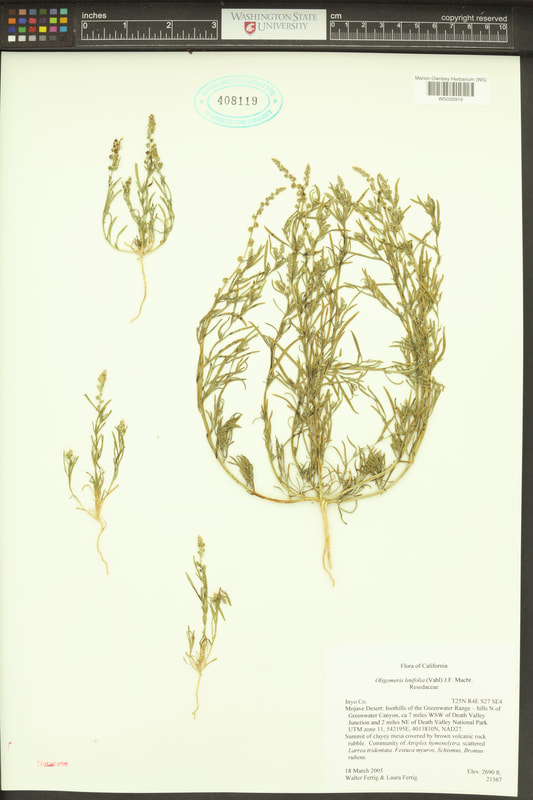
Flaxleaf whitepuff (Oligomeris linifolia)

Flaxleaf whitepuff (Oligomeris linifolia) is an easily overlooked annual desert plant with an unusual backstory. This bushy-stemmed member of the Mignonette family (Resedaceae) is characterized by linear, succulent leaves and a narrow, spike-like inflorescence of small, greenish-white flowers. The species is atypical in being 2-merous (with floral parts in multiples of 2), rather than 4 […]

Flaxleaf whitepuff (Oligomeris linifolia).

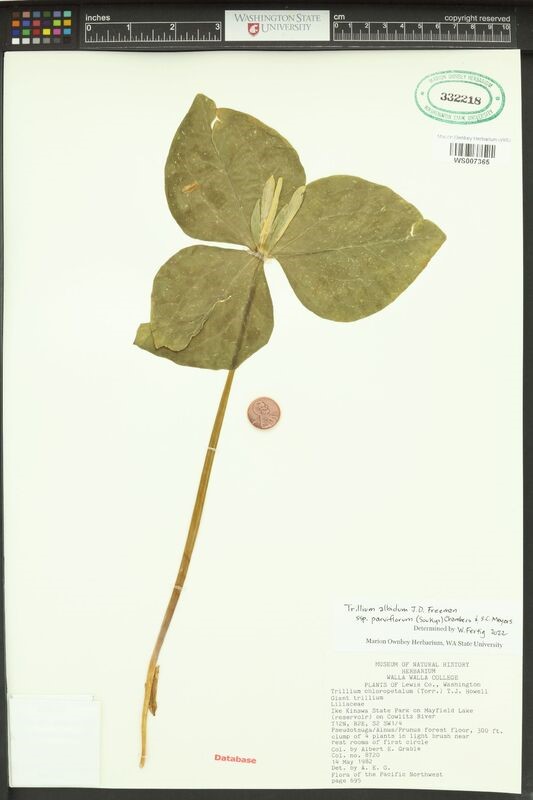
Small-flowered trillium (Trillium albidum subsp. parviflorum)

As a general rule, people avoid complicated Latin names for plants. But in some cases, the Latin name is descriptive or mellifluous enough for common use. One such example is the genus Trillium, known from about 50 species in North America and eastern Asia, and easily recognized by its showy three-petaled, lily-like flowers and whorls […]

Small-flowered trillium (Trillium albidum subsp. parviflorum)

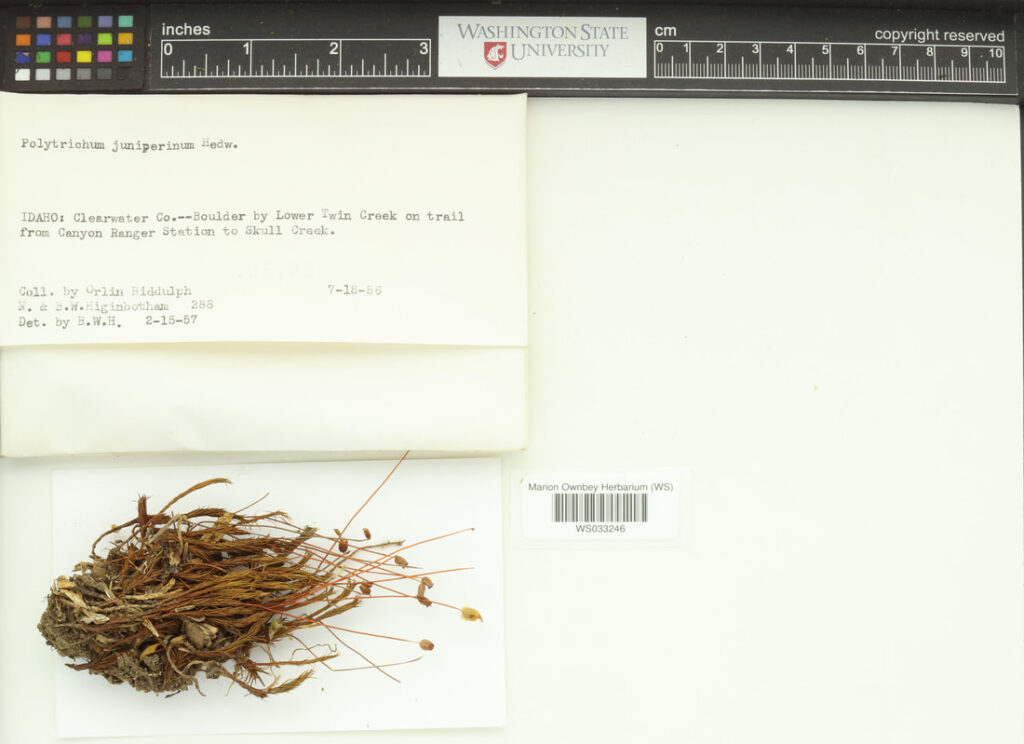
Juniper haircap moss (Polytrichum juniperinum)

As we all learned in Botany 101, bryophytes (mosses, liverworts, and hornworts) differ from vascular plants (ferns, conifers, and flowering plants) in that they lack xylem and phloem (specialized vascular tissue) to transport water and sugary food, respectively. The Juniper haircap moss, and some other members of the genus Polytrichum, bend this rule by having […]

Juniper haircap moss (Polytrichum juniperinum).

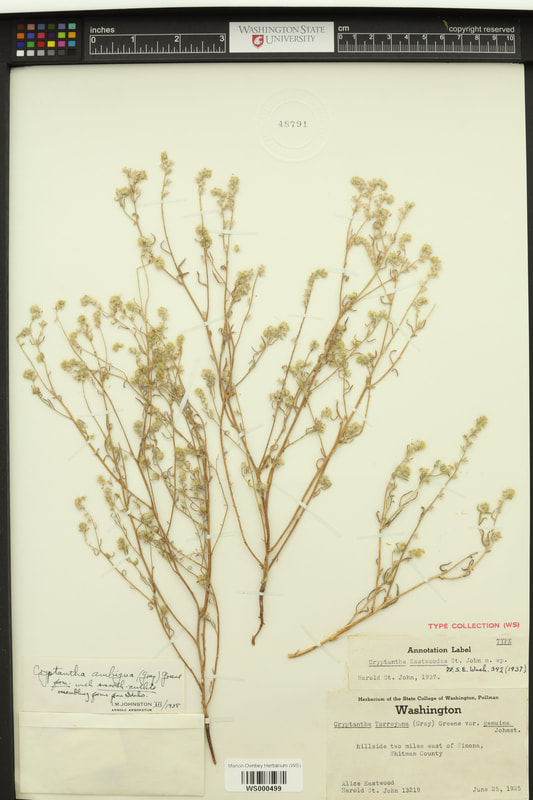
Obscure cat’s-eye (Cryptantha ambigua and C. eastwoodiae)

During the first half of the 20th century, many botanical luminaries passed through Pullman to visit the WSU herbarium and botanize the surrounding countryside. One of the brightest of these visitors was Alice Eastwood, head of the Department of Botany at the California Academy of Sciences from 1894-1949. Eastwood was an expert on the flora […]

Obscure cat’s-eye (Cryptantha ambigua and C. eastwoodiae)

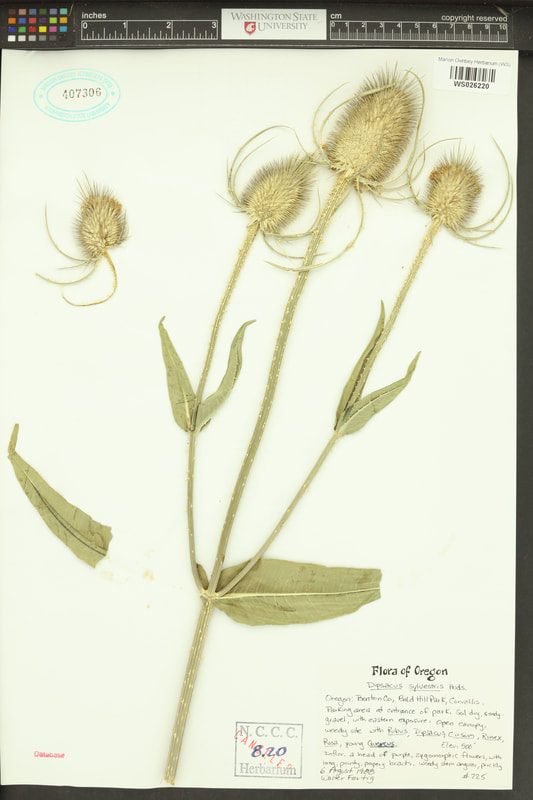
Teasel (Dipsacus sylvestris or D. fullonum)

“Weed” is one of those rare botanical terms without a precise meaning. Often, a weed is considered “a plant growing out-of-place”. Such a definition is broad enough to include both native and introduced species, as well as plants that are adapted to disturbed sites. A few weeds were originally imported for their economic use, but […]

Teasel (Dipsacus sylvestris or D. fullonum).

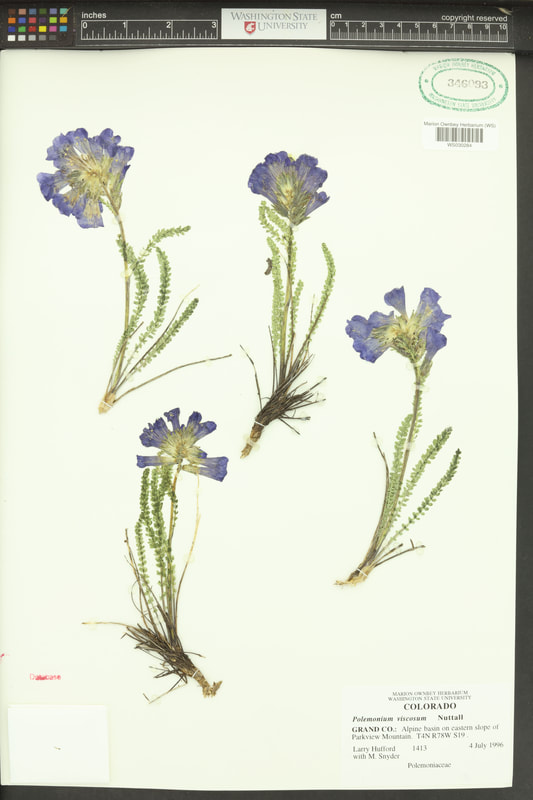
Sky pilot (Polemonium viscosum)

Hikers who make it above tree line of the higher summits of the Rocky Mountains in summer are rewarded with dazzling displays of alpine wildflowers. One of the showier species is sky-pilot or sticky polemonium (Polemonium viscosum), characterized by its ball-like cluster of blue-purple bell-shaped flowers borne above extremely sticky pinnately divided leaves. More often […]

Sky pilot (Polemonium viscosum).