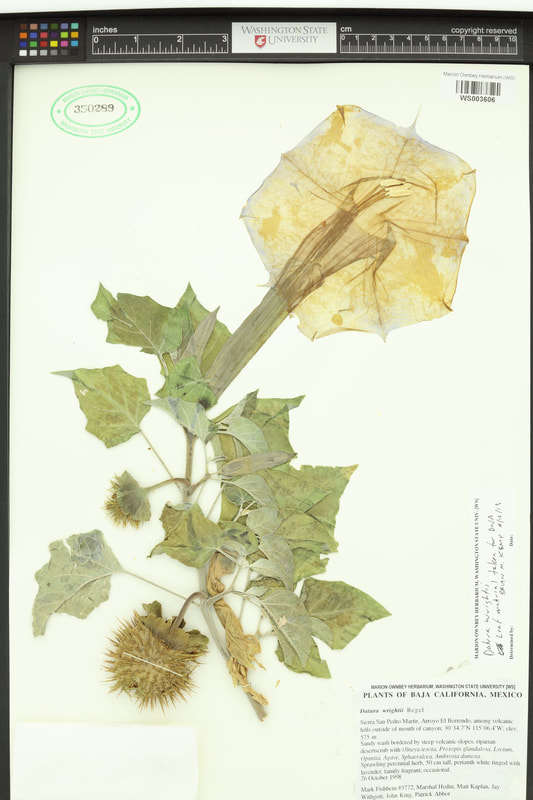
The genus Datura contains about 25 species found worldwide in tropical and warm temperate areas, including North America. Like many members of the nightshade family (Solanaceae), Datura species are deadly poisonous, though they were used (carefully) by indigenous cultures as a narcotic and to induce hallucinations. All parts of the plant (leaves, stems, fruits, flowers, and even nectar and pollen) contain various alkaloids, such as atropine, hyoscyamine, and scopalomine. Naturalists have observed hawkmoths and hummingbirds behaving erratically around Datura flowers, perhaps as a result of intoxication from these compounds. Pollinators may become “Jimsonweed junkies”, going from one Datura flower to another for their next fix, thus being manipulated by their pusher-plant to promote cross-pollination.
Datura wrightii is native to the deserts of the southwestern US and Mexico, though it has escaped from cultivation or appears as a waif as far away as Washington State. American artist Georgia O’Keefe frequently incorporated Datura into her iconic paintings of the southwest (her most famous rendering of the species hangs in a museum in Indiana and is valued at 44 million dollars). Datura wrightii is also noteworthy for having the largest flowers of any native western US plant, with its white, funnel-shaped flowers often reaching 8 inches in length.
The specimen shown here was collected by former WSU Postdoctoral student Mark Fishbein and associates on a collecting expedition to Baja California in 1998. The Ownbey Herbarium has specimens from over 80 countries around the world, with Mexico having the third most collections, after the US and Canada. – Walter Fertig, collections manager, Marion Ownbey Herbarium.