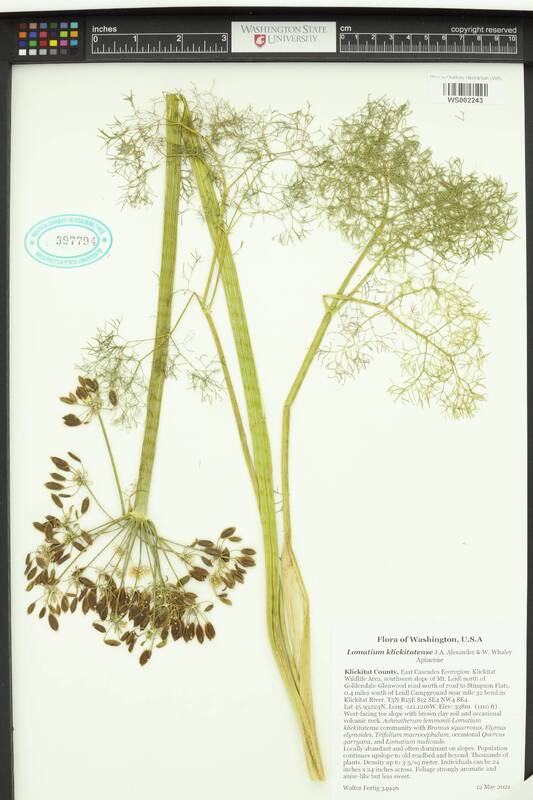
Sometimes insects make pretty good taxonomists. At least that is what entomologist Wayne Whaley discovered when examining the favorite host plants of Indra swallowtail butterfly caterpillars. Across the western US, Whaley observed Papilo indra caterpillars feeding on some, but not all, populations of the widespread umbel species, Gray’s biscuitroot (Lomatium grayii). Systematist Jason Alexander of the Jepson Herbarium undertook a detailed analysis of hundreds of specimens of L. grayii across its range and discovered consistent morphological differences that correlated with geography and the feeding habits of Indra caterpillars. A companion study also found consistent differences in the essential oils present in the foliage of these different populations. In 2018, Alexander, Whaley, and Natalie Blain published a paper splitting L. grayii into four species: L. papilioniferum (for the Indra butterfly) of the Pacific Northwest, L. depauperatum (endemic to Utah and Nevada), L. grayii proper (now restricted to SE Idaho, E Utah, Colorado, and Wyoming) and L. klickitatense, endemic to the Klickitat River drainage and vicinity in southern Washington and adjacent Oregon.
Klickitat biscuitroot (L. klickitatense) differs from the more widespread L. papilioniferum in being much more robust (with leaves and stems up to 3 feet tall and wide) and having more finely divided leaves with long, narrow leaflets that are smooth, rather than rough (scabrous). It is locally abundant within its narrow range and easy to spot along the red cliffs on the Goldendale-Glenwood Highway and Highway 142 along the Klickitat River. Ironically, this species does not appear to have ever been collected by Wilhelm Suksdorf, Washington’s preeminent pioneer botanist and longtime resident of nearby Bingen in the Columbia Gorge. Over a dozen collections of L. klickitatense were made in the 1960s and 1980s (including many by a WSU graduate student studying chemical properties of Lomatium species), but it remained undetected in the herbarium folders. What other unnamed species may be lurking in the cabinets?
– Walter Fertig, collections manager, Marion Ownbey Herbarium.