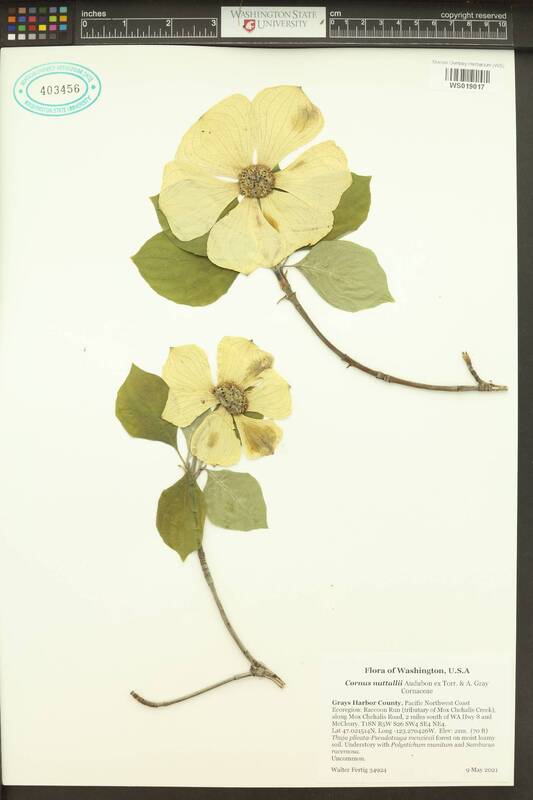
How many flowers do you see on each of these branches of Pacific dogwood? If you answered “one” on each stem, don’t feel too bad. Most people would agree with you. Of course, you would all be wrong. The correct answer, to use the technical botanical term, is “lots”. Each dogwood flower is actually a ball-like inflorescence of several dozen tiny, 4-petaled, greenish-white to purplish flowers surrounded by 4-7 large, whitish, petal-like bracts (technically leaves) that create the illusion of a single flower. The petals on dogwood are analogous to the red “petals” of a Christmas poinsettia, though these are leaves too.
Pacific dogwood is closely related to the flowering dogwood (C. florida) of the eastern United States. Early botanical explorers in the northwest, including Meriwether Lewis and David Douglas, assumed the showy trees were one and the same species. Thomas Nuttall was the first scientifically trained botanist to note the difference (C. florida has only 4 petal-like bracts and fruits that are round, rather than angular in cross-section). Nuttall was a contemporary of John James Audubon and sent a sprig of Pacific dogwood and some bird skins to his artist friend as a gift. Audubon scooped Nuttall and published Cornus nuttallii as a new species – having the decency to at least name it after Nuttall. This was the first and only plant species ever scientifically described by Audubon.
True to its common name, Pacific dogwood ranges mostly near the Pacific Ocean from southwestern British Columbia and western Washington, south through Oregon to southern California. Nearly all populations are found in and west of the Cascade Range. Some isolated populations are disjunct in the Selway-Lochsa river drainage of northern Idaho, where rainfall and temperature patterns locally mimic the wet northwest coast. Nearly 100 “coastal disjunct” plant species show a similar geographic pattern in Idaho, raising the question of whether these species have persisted following post-glacial climate changes in the intervening areas, or arrived from long distance dispersal. – Walter Fertig, collections manager, Marion Ownbey Herbarium.