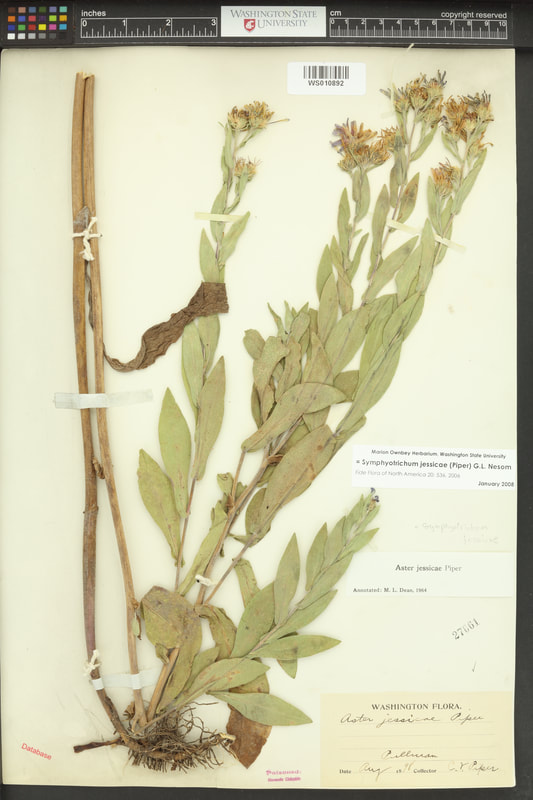
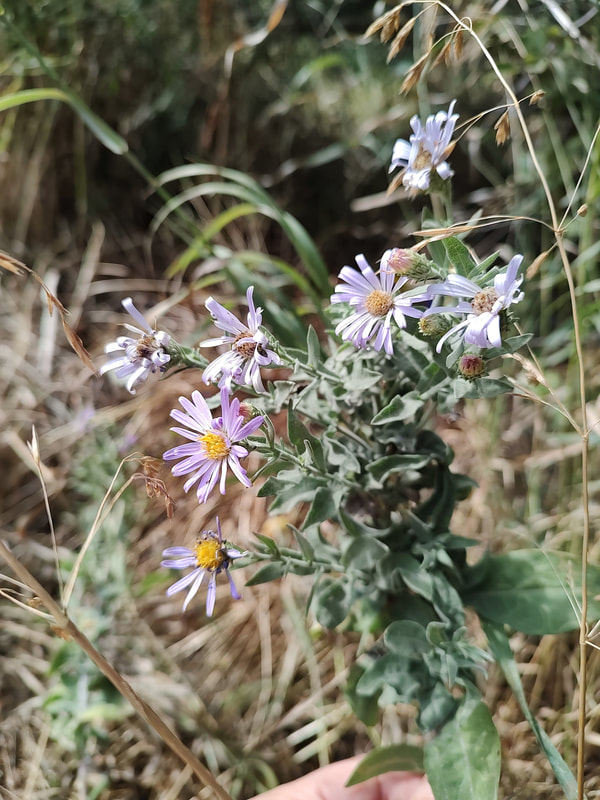
Jessica’s aster is endemic to the Palouse region of southeastern Washington and west-central Idaho. Historically, it probably occurred on drier stream terraces and at the transition between prairie grasslands and ponderosa pine forests. Over the past 150 years most of its habitat has been converted to farm fields, but small remnant populations persist along roadsides and undeveloped streams, such as the Rose Creek Preserve northwest of Pullman.
The species was first recognized and named by Charles Vancouver Piper, the first botanist on the faculty of Washington State College (now Washington State University) and founder of the WSU herbarium. Among his many contributions to botany, Piper wrote the first statewide flora of Washington in 1906 and the first flora of the Palouse Region in 1901 (later expanded to the Flora of Southeastern Washington and Adjacent Idaho). Piper left Pullman in 1903 to work for the US Department of Agriculture, where he helped introduce new forage grasses (such as Sudan grass from Africa), developed grass cultivars widely used on golf courses, and helped popularize the cultivation of soybeans.
The origin of the name “Jessica’s aster” is a bit of a mystery. Piper makes no mention of the inspiration for the name in his original description of the species in 1898. The Latin epithet jessicae is clearly feminine, so it had to be named for a Jessica. Piper’s spouse, however, was named Laura, and the couple was childless. Perusing digital herbarium collections from the 1890s in SEINet, I could find no mention of any botanists from the Pullman or Moscow areas named Jessica. It finally occurred to me that Piper may have been invoking the name Jessica from Shakespeare’s “Merchant of Venice”, in which Jessica is the daughter of the moneylender Shylock. Jessica is derived from the biblical name “Iscah”, which translates as vision, or sight. Jessica’s aster is a beautiful, 4 ft tall aster with bright purple flowers, so perhaps was a delightful vision to Piper. At least that is my story, and I am sticking with it.
To view more specimens of Jessica’s aster, go to the WSU herbarium database (Consortium of Intermountain Herbaria Collection Search Parameters (intermountainbiota.org)
-Walter Fertig 28 May 2024