As we all remember from Botany 101, all seed and spore producing green plants have an “alternation of generations” life cycle, in which a spore-bearing phase (sporophyte) alternates with a gamete-producing phase (gametophyte). In flowering plants, the gametophyte is reduced to just a few cells within the stamens and ovaries of a flower that ultimately give rise to pollen and ovules, respectively (I am simplifying this a whole lot!). Bryophytes, ferns, and lycopods (club-mosses and their relatives) are unusual in that the gametophyte and sporophyte are separate, free-living individuals that differ in chromosome number and appearance. In bryophytes (mosses and liverworts), the gametophyte is the dominant phase in the life cycle and comprises the leafy or flattened blob-like body (thallus) we associate with these minute plants. The sporophyte is short-lived and reduced to a slender or bulbous capsule borne on a slender stalk that depends on the gametophyte for most of its nutrition. Ferns and lycopods are the opposite, with the sporophyte phase being the dominant form we are most familiar with (and which bear spores on the underside of leaves or in cone-like structures), while the gametophyte is a miniscule, branched or ribbon-like green blob that might be mistaken for a baby moss.
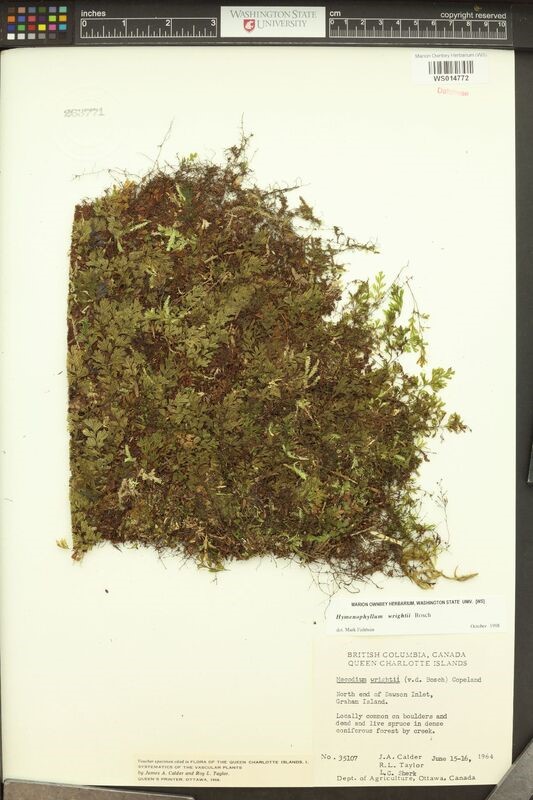
Wright’s filmy fern (Hymenophyllum wrightii) is unusual among ferns in being able to persist entirely as the ribbon-like gametophyte phase, bypassing the sporophyte generation. It is able to do this by producing asexual propagules called gemmae, which are genetically identical to its parent plant and able to waft through the air or float through rainwater to establish new individuals. Most filmy ferns are tropical species that live as epiphytes on the stems or trunks of other plants. This species is primarily found in Japan and Korea, but an isolated population was discovered on Haida Gwaii (Queen Charlotte Islands) off the coast of British Columbia in the 1950s. This population is the only one known from North America that has the sporophyte phase, shown in the herbarium specimen from Canadian botanist James Calder (who co-authored the first flora of the archipelago). Other populations have since been discovered in southeast Alaska, British Columbia, and the Olympic Peninsula of Washington that consist entirely of gametophytes. A recent genetic analysis confirmed that the North American gametophyte populations are genetically similar to each other and share similar genes with populations from Asia (though some differences have also emerged since they became established).
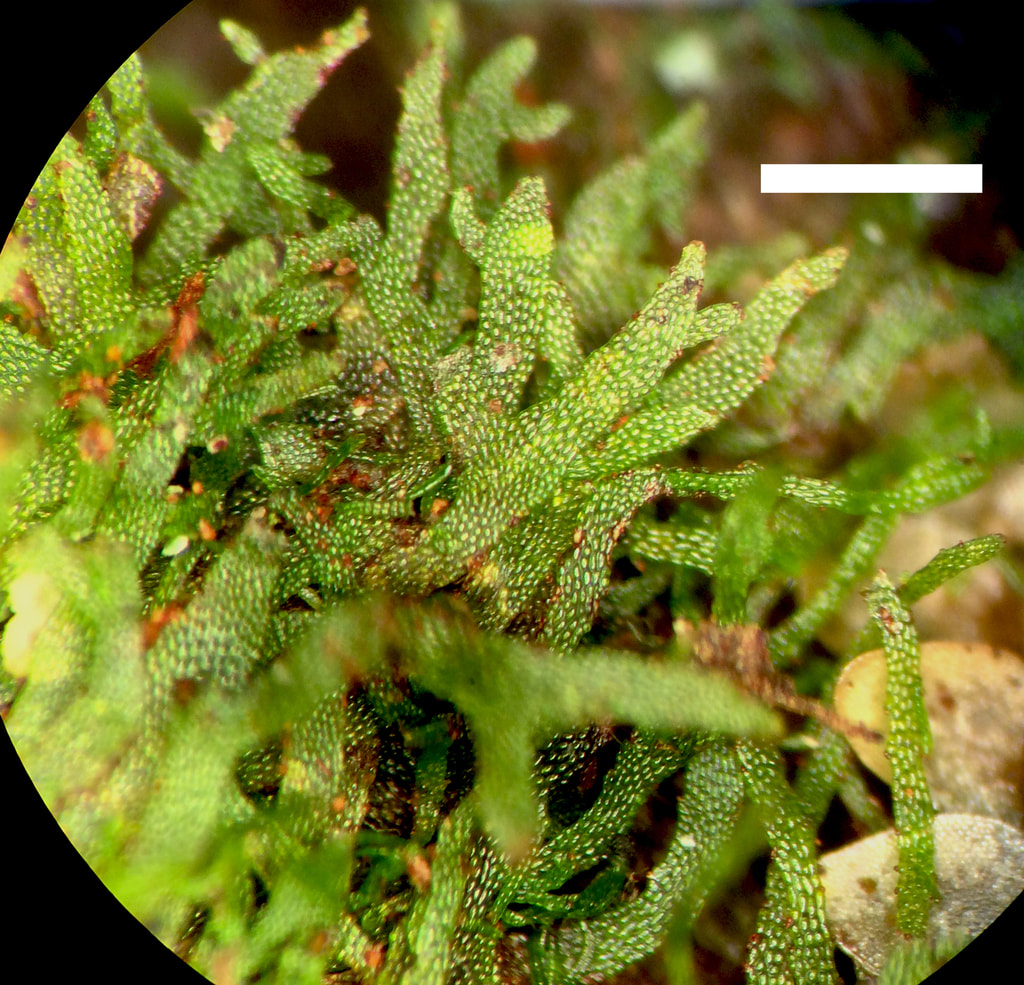
Filmy fern gets its common name from the very thin leaf blades (often just a few cells thick) of the sporophyte form. The gametophytes of Wright’s filmy fern are ribbon-like and branched (see photo by Peter Zika). They grow on wet cliffs, on the surface of trees, or inside rotting stumps and logs. All known populations are found near the Pacific Ocean, where fog may be critical to ensure the plants stay adequately hydrated – Walter Fertig, 9 June 2024.