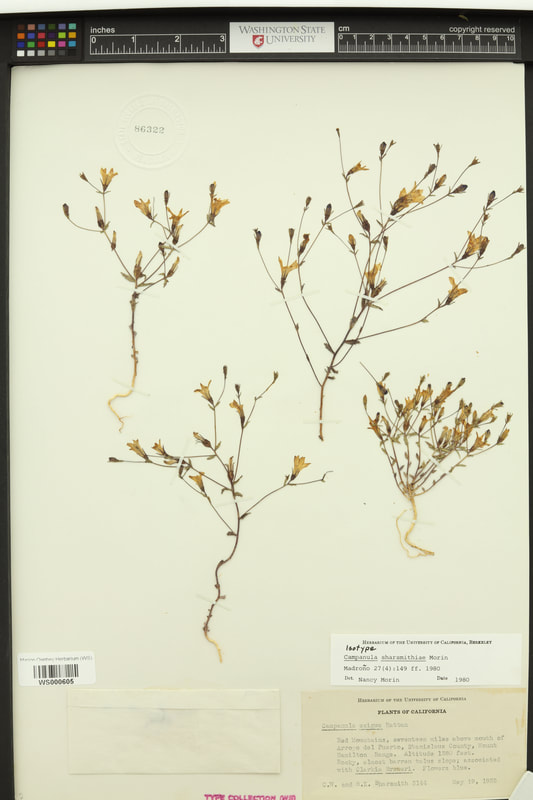
The Ownbey Herbarium contains more than 415,000 specimens of vascular plants, bryophytes, and lichens. Over 1,500 of these specimens are “types”, which were formally designated by the authors of a new species as the best (most typical) representation of that species. Taxonomists studying plant diversity refer to types when reclassifying organisms or inferring evolutionary relationships.
One of the types in our collection is an isotype of Campanula sharsmithiae, collected by (and named for) California botanist Helen K. (Meyers) Sharsmith. This slender, low-growing annual has oversized, purple, bell-shaped flowers (faded to brown on the herbarium sheet), narrow serrated leaves, and raised bumpy papillae on the ovary surface. It is restricted to talus slopes in the Mount Hamilton Range, east of San Jose, California. Helen Sharsmith received her PhD for research on the flora of this interesting area at the University of California, Berkeley in 1940. With her husband, Carl, she collected the type specimen in 1935, but believed it represented a closely related serpentine endemic of the San Francisco Bay area. Nancy Morin, then a PhD student at Berkeley herself, recognized that the Mount Hamilton plants were unique and published C. sharsmithiae as a new species in recognition of Helen’s many contributions to California botany. Based on more recent phylogenetic studies, Morin split the genus Campanula into six more natural genera in a 2020 paper. Campanula sharsmithiae is now in the genus Ravenella with three other annual California endemics. The new genus is named for yet another famous Golden State botanist, Peter Raven.
The Sharsmiths have a connection to Pullman, Washington. From 1937-1939, Carl Sharsmith was a botany instructor and curator of the WSU herbarium, while Helen was completing her dissertation. In later years, Carl became a reknowned naturalist at Yosemite National Park, where he served as a ranger into his 90s. Helen returned to Berkeley where she served as the Senior Herbarium Botanist from 1950-1969. Three other plant species are named after the Sharsmiths. A Draba and Hackelia are named for Carl (with the masculine Latin epithet sharsmithii) and a rare Allium endemic to the Mount Hamilton area for Helen (with the feminine epithet sharsmithiae). – Walter Fertig, 4 July 2024