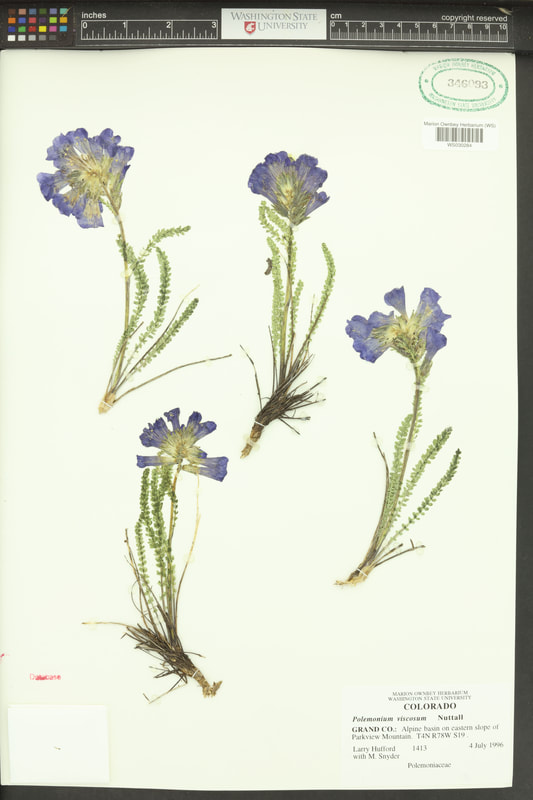
Hikers who make it above tree line of the higher summits of the Rocky Mountains in summer are rewarded with dazzling displays of alpine wildflowers. One of the showier species is sky-pilot or sticky polemonium (Polemonium viscosum), characterized by its ball-like cluster of blue-purple bell-shaped flowers borne above extremely sticky pinnately divided leaves. More often than not, unsuspecting admirers stopping to take a whiff of the blooms will be greated by a strong, skunky odor emanating from the flowers (earning the species another common name, skunk polemonium). But sometimes, the flowers have a sweet aroma instead. What gives?
Flower scent often serves to attract pollinators, who are rewarded with sweet nectar or a meal of pollen. Offering a reward entices pollinators to be “faithful” and travel from flower to flower and plant to plant of the same species, thus not wasting pollen on the wrong species. Sweet-smelling sky-pilot flowers attract large bumblebees, which are especially efficient and loyal pollinators. Stinky flowers can also attract insects, such as flies, which are less efficient pollinators and tend to visit multiple flowering species. But the smelly flowers (called mephitic, after the Latin name for skunk) have another purpose – to deter ants which visit the flowers of sky-pilot not to help with pollination, but to feed on the ovaries and unripened seeds. The sky-pilot hedges its bets – producing some sweet smelling flowers to attract reliable pollinators, but also having some stinky flowers to repel seed predators. This is a winning strategy in alpine habitats where the growing season is short, and there is no time to waste in getting seeds fertilized and ready for dispersal.
Sky-pilot ranges from southern British Columbia and Alberta, south to NE Oregon, Colorado, Utah, and northern Arizona. Disjunct populations occur in the Okanogan Mountains of Washington. These populations are restricted to alpine outcrops of Cretaceous marine sediments or intrusions of granodiorite or tonalite, all of which are uncommon rock types in the state. Not surprisingly, sky-pilot is on the Washington Natural Heritage Program State Sensitive plant species list. It is considered one of the most vulnerable plant species in the state to climate change, particularly as snowpack diminishes and air temperatures rise in its narrow alpine range. – Walter Fertig, 21 July 2024