As a general rule, people avoid complicated Latin names for plants. But in some cases, the Latin name is descriptive or mellifluous enough for common use. One such example is the genus Trillium, known from about 50 species in North America and eastern Asia, and easily recognized by its showy three-petaled, lily-like flowers and whorls of three broad leaves (technically bracts) below the flowers. Trillium comes from the Latin trilix, or triple, for the floral and leaf parts being in threes.
About half of the Trillium species of North America are of conservation concern, based on a 2022 report published by NatureServe (the national network of state heritage programs), the International Union for Conservation of Nature, Mt. Cuba Center, and others (Meredith et al. 2022, https://www.natureserve.org/publications/conservation-status-trillium-north-america). Many species from the west coast and southeastern United States are narrow endemics, making them especially vulnerable to broadscale loss of habitat from development, logging, changes in hydrology, and competition with invasive weeds.
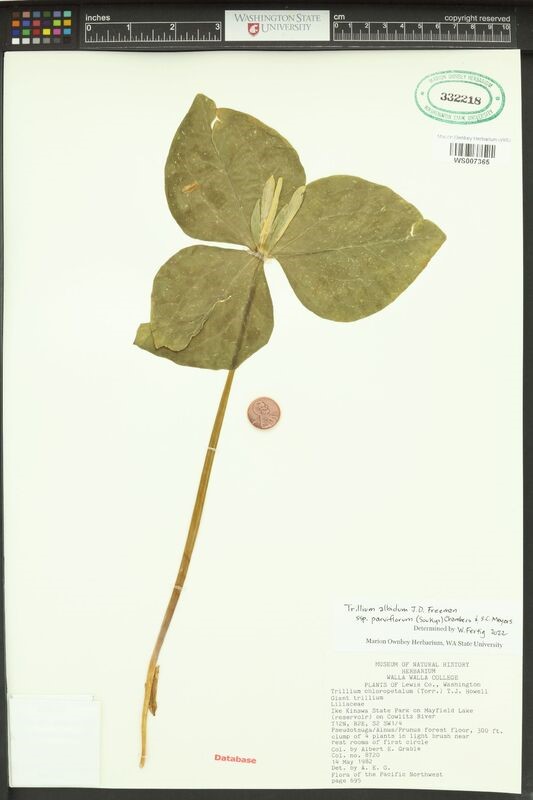
Small-flowered trillium is restricted to the southern Puget Trough and northern Willamette Valley in SW Washington and NW Oregon. This species is easily recognized by its small, stalkless, white-petaled flowers that are immediately subtended by 3 broadly oval leaves and its spicy, clove-like aroma. It occurs in moist, shady areas in Oregon ash (Fraxinus latifolia), Garry oak (Quercus garryana) and red alder (Alnus rubra) forests on alluvial soils over former glacial scour. When it was first named in 1980, parviflorum was thought to be a separate species, but recent genetic studies suggest it should be treated as a subspecies of Trillium albidum of Oregon and California, a taxon with larger flowers. Like other Trillium species, small-flowered trillium produces seeds bearing oily or protein-rich structures (elaisomes) that provide food for ants and wasps (the insects help plant the seeds when they carry them to their underground nests).
The specimen shown here was collected by the late Albert Grable, a long-time biology professor at Walla Walla University who traveled widely in the US and Canada to add plant specimens to the university herbarium. In 1994, the Walla Walla herbarium (containing more than 15,000 mounted and unmounted sheets) was donated to Washington State University, where it is now part of the Ownbey collection. – Walter Fertig, October 27, 2024