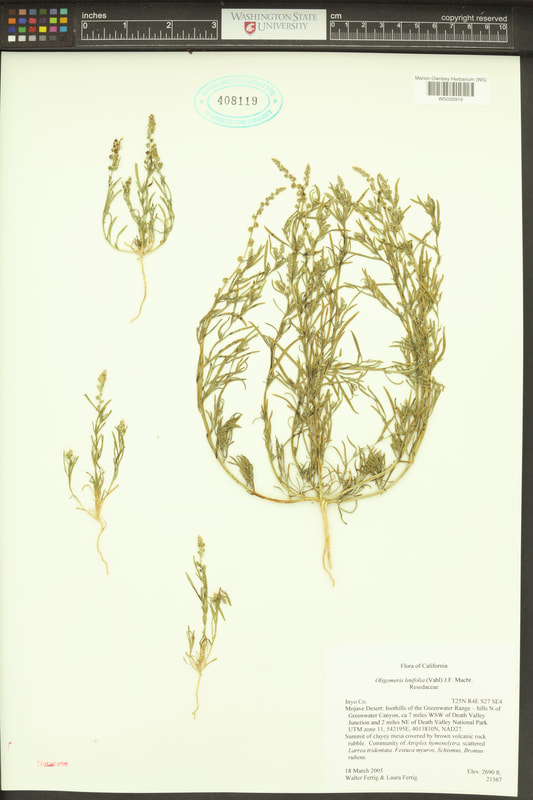
Flaxleaf whitepuff (Oligomeris linifolia) is an easily overlooked annual desert plant with an unusual backstory. This bushy-stemmed member of the Mignonette family (Resedaceae) is characterized by linear, succulent leaves and a narrow, spike-like inflorescence of small, greenish-white flowers. The species is atypical in being 2-merous (with floral parts in multiples of 2), rather than 4 or 5 as in most dicots. Mature fruits resemble a warty sac that splits at the top to release numerous tiny seeds.
Intrepid western botanist Thomas Nuttall made the first scientific collection of flaxleaf whitepuff in North America near Santa Barbara, California, in 1836. He named his plants Ellimia ruderalis, assuming it was an undescribed species. Many years later, taxonomists realized that the California plants were morphologically identical to Oligomeris linifolia, from the deserts of North Africa and the Middle East. In North America, O. linifolia occurs in rocky desert sites from southern California to Texas and northern Mexico.
For many years, it was assumed that flaxleaf whitepuffs must have been introduced to North America by humans during the era of European colonization, even though it frequently occurs in undisturbed, natural-appearing habitats. In 2009, Santiago Martin-Bravo and colleagues used ribosomal and chloroplast DNA markers to assess the genetic similarity between North American and Middle Eastern populations and determine when the populations became isolated. The researchers found low degrees of genetic differentiation between the Old and New World populations, suggesting that their split occurred relatively recently. However, the team also discovered several genetic markers unique to the North American populations, indicating that they have been isolated for tens of thousands of years – well before the arrival of Europeans. The most likely explanation for the disjunct distribution of Oligomeris linifolia is a long-distance dispersal event between the Middle East (where the species likely originated) and southwestern North America in the late Quaternary – perhaps mediated by wayward birds or exceptionally strong winds.
A similar pattern of ancient, long-distance dispersal from the deserts of the Middle East to the American Southwest has been documented in Senecio and Plantago. In these latter cases, enough morphological and genetic divergence has occurred since the Pleistocene so that the North American plants are now considered separate species (Senecio mohavensis and Plantago insularis). Perhaps, given a few more thousand years, the same will happen with Oligomeris and Nuttall will be vindicated. – Walter Fertig 8 October 2024