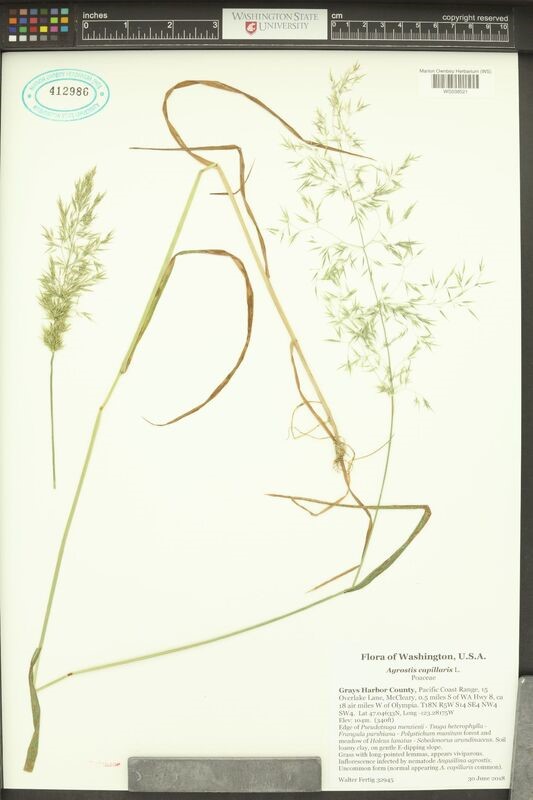
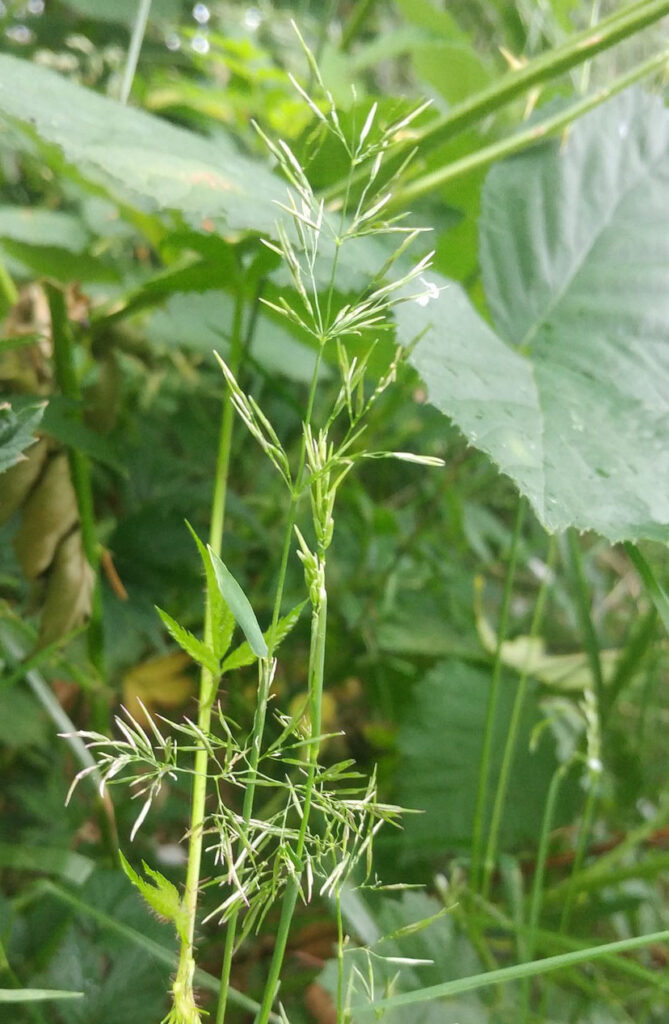
Galls are tumor-like growths on leaves, stems, flowers, or roots, formed by plants in response to herbivory or egg-laying by various insects (especially wasps and aphids), mites, bacteria, fungi, or nematodes. Flower galls can be deleterious to plants by reducing seed production. For taxonomists, flower galls can make species identification a real challenge.
The grass specimen shown here, colonial bentgrass (Agrostis capillaris) has been infected by a nematode (Anguina agrostis) which specializes in parasitizing flowers of Agrostis and several other grass genera. Typical colonial bentgrass has relatively short, rounded clusters of green, petal-less flowers (called florets) borne in wispy, open inflorescences. Florets infected by nematodes are about four times longer than normal and have pointed tips. Gall-bearing colonial bentgrass plants look so distinct that they were once named a separate species, Agrostis silvatica, in their native Europe.
Nematodes are tiny invertebrates that belong to their own phylum (though distantly related to tardigrades and arthropods). Most are only 1000-4000 microns long (for comparison, a human hair is about 100-180 microns thick). Nematodes are the most abundant animals on Earth, outnumbering humans by 60 billion to one and are ubiquitous in every ecosystem, but particularly in water and soil.
Bentgrass galls form in response to invasion of developing ovules by the motile juvenile phase of the nematode after it passes from the soil and up the growing grass stem to the inflorescence. Within the growing gall, juveniles feed on plant tissues and molt three times before maturing into adults. After mating, the female nematode lays hundreds of eggs inside the protective shell of the gall. After hatching, juveniles become dormant and overwinter inside the gall before emerging the following spring to find a new host. Humans have helped transport bentgrass nematode and colonial bentgrass over most of northern Europe, Russia, northern North America, South Africa, and Australia.
I will admit being flummoxed when I collected this specimen. I knew it was an Agrostis, but it did not match any of the species in the identification manuals at my disposal. Fortunately, I showed a photo to Ben Legler, coauthor of the second edition of the Flora of the Pacific Northwest, who recognized it as the gall-infected phase of Agrostis capillaris and solved the mystery. – Walter Fertig, 15 January 2025