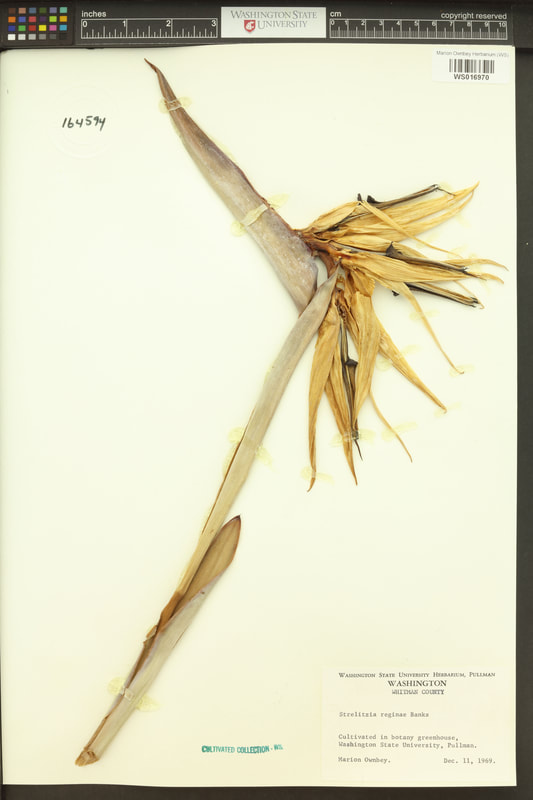
In its native South Africa, this species is commonly called crane flower for its resemblance to the crowned crane (Balearica pavonina), a long-necked water bird with a stout beak and headdress of golden plumes. Elsewhere, it is called the bird-of-paradise (Strelitzia reginae), which is confusing, since it is a plant (one of 7 species in the monocot family Strelitziaceae) and not a bird at all! The avian Birds-of-Paradise are brightly colored denizens of New Guinea and Australia. Their name comes from an early misconception that they lacked feet (the first skins to arrive in Europe had the feet removed) and so were in constant flight, as if descending from Paradise itself.
How this plant got its scientific name is an equally strange story. Bird-of-paradise was first brought to Europe in the 1770s and created a sensation as the new “it” plant for wealthy gardeners. Sir Joseph Banks, England’s most famous 18th Century botanist and a friend of King George III, helped popularize the species by being one of the first people to grow it at Kew Gardens. Banks was eager to use his royal connections (and the king’s largesse) to transform Kew into the world’s pre-eminent botanical garden. So, Banks named the exotic plant Strelitzia after the Queen, Sophia Charlotte of Mecklenburg-Strelitz (who was herself an amateur botanist). In case that bit of pandering wasn’t subtle enough, Banks added the epithet reginae (for “queen”). Queen Charlotte hailed from the northern German duchy of Mecklenburg-Strelitz, a world away from the Cape Province of South Africa where her namesake plant was native.
Bird-of-paradise (the plant) has flowers with three enlarged, bright gold to orange sepals that enclose a pair of blue-purple arrowhead-shaped petals. A third, smaller petal produces nectar that attracts sunbirds (an African bird with a similar ecological niche as the hummingbird) to the inflorescence. Unlike hummingbirds, sunbirds can’t hover in flight, but instead land on the stiff green bracts at the base of the flower stalk. As the birds drink nectar, the petals split apart to expose sticky pollen that lands on their feet. When the sunbird travels to another bird-of-paradise plant it delivers the pollen to the stigma of the next flower it drinks at, ensuring pollination. In a bit of irony, a plant named after a bird that supposedly had no feet is actually pollinated by the feet of a bird. – Walter Fertig, 20 February 2025