Penstemons or beardtongues (genus Penstemon) are among the showiest native plants in North America, with large, colorful flowers varying from white, yellow, and red to every shade of blue or purple. Not surprisingly, penstemons have a devoted fan base (followers call themselves penstemaniacs) who even have their own organization, the American Penstemon Society.
Penstemon is the largest genus of vascular plants restricted to North and Central America, with 240-270 recognized species. Andrea Kramer and colleagues from the Chicago Botanic Garden have found that bee-pollinated blue or purple-flowered penstemons tend to be genetically distinct on different mountain ranges because their insect benefactors have relatively short foraging ranges. Over time, isolated populations can diverge into new species or varieties. By contrast, red and orange-flowered hummingbird-pollinated species are more genetically similar across large areas because their pollinators can travel widely.
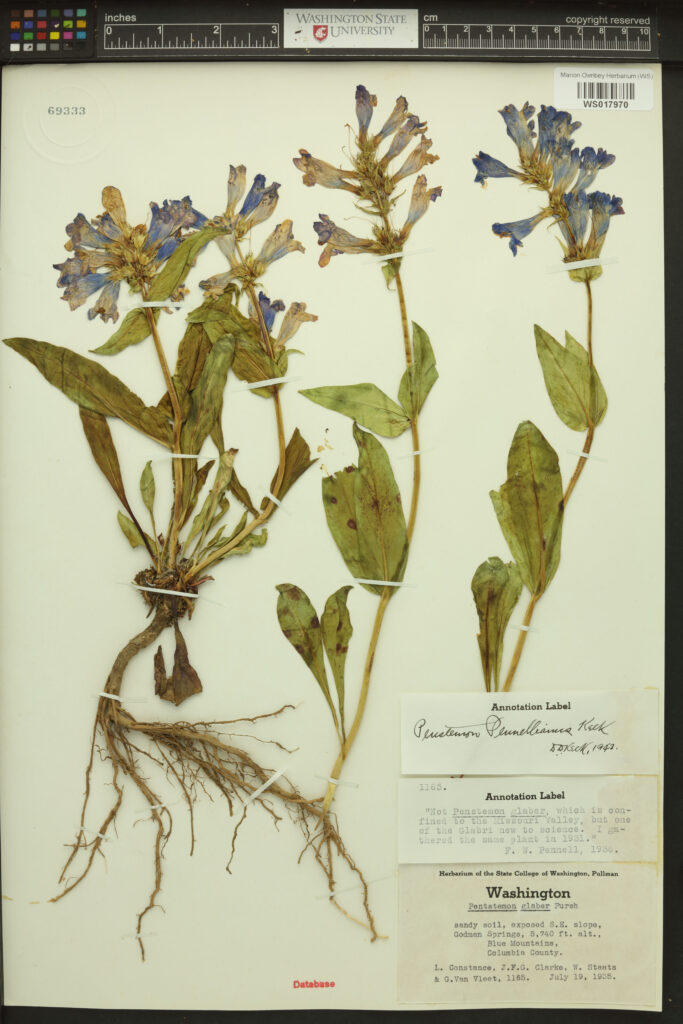
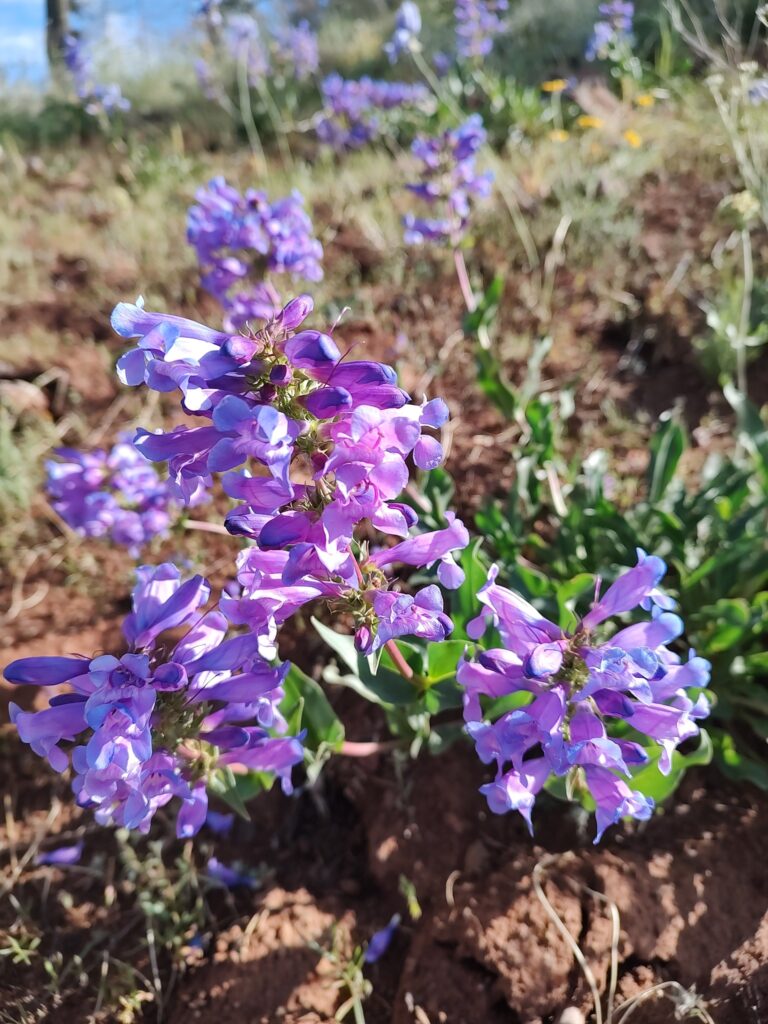
One recently evolved species is the Blue Mountain beardtongue (Penstemon pennellianus). As its common name suggests, this species is restricted to the Blue Mountains of southeastern Washington and adjacent Oregon. It can be recognized by its broad, oval, opposite leaves and terminal cluster of sky-blue flowers, each up to 1 inch long. The corolla is two-lobed and has an inflated tube that nicely accommodates its pollinators (bumblebees and large wasps). Like all penstemons, P. pennellianus has 4 fertile (pollen-bearing) anthers and a fifth, vaguely tongue-shaped sterile stamen tipped with yellow hairs (the “beard” in beardtongue). Far from being superfluous, the sterile stamen (or staminode) helps control access to the precious nectar at the base of the floral tube – keeping out insects that are too small to effect pollination. Historically, Blue Mountain beardtongue was probably limited to shallow, rocky sites along ridgetops and rims, but today is often seen on sunny roadcuts.
The Latin name pennellianus honors Francis W. Pennell, a 20th century Pennsylvania botanist and Penstemon specialist who named over 50 new species, including many narrow endemics. For years, the Blue Mountain beardtongue befuddled experts who thought it might be a Rocky Mountain species, P. glaber (as shown on the original label of the specimen collected by Lincoln Constance, curator of the WSU herbarium in the mid 1930s). Pennell suspected it might be a new species, but it remained unnamed until another beardtongue expert, David Keck, formally described it in 1940. – Walter Fertig, 7 April 2025