Wilhelm Friedrich Benedikt Hofmeister (1824-1877) may be the most important botanist you have never heard of. In the mid-19th Century, Hofmeister published a series of papers and books that laid the foundation of modern plant anatomy, cell biology, and reproductive biology. Remarkably, Hofmeister was entirely self-trained as a botanist; his early career was in the music publishing business in his native Leipzig, Germany.
Hofmeister was extremely near-sighted, which would have been a severe handicap for a field botanist. But he compensated for poor vision by being a virtuoso with a microscope. Hofmeister was also a skilled artist and keen observer. These traits, coupled with a mind unencumbered by prevailing theory, allowed the amateur to make numerous fresh discoveries. Hofmeister was the first botanist to correctly deduce how plants reproduced sexually via modified eggs and sperm. More importantly, he discovered the phenomenon of alternation of generations in which plants have two distinct phases in their life cycle: a spore-producing stage (sporophyte) alternating with a separate gamete-producing phase (gametophyte). His discovery that alternation of generations was present in one form or another among all plants (algae, bryophytes, ferns, conifers, and angiosperms) provided strong evidence for their genealogical relationship, supporting Darwin’s new theory of evolution by natural selection.
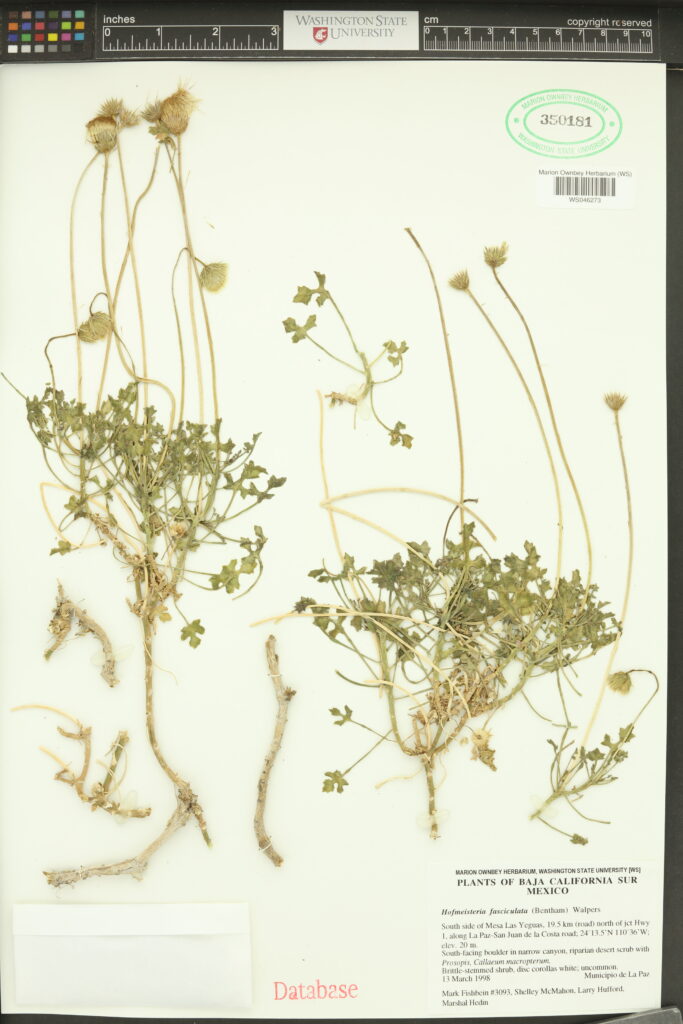
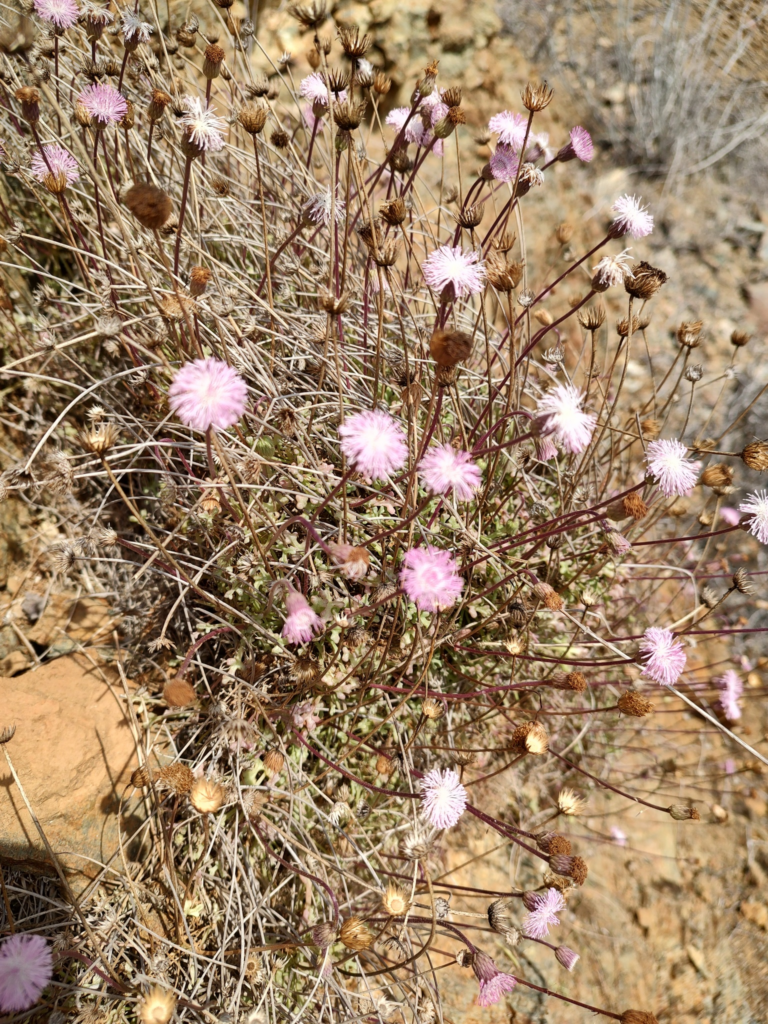
In recognition of his scholarship, Hofmeister was appointed to head the botany departments at Heidelberg and Tubingen universities. Unfortunately, his later years were marked by personal tragedies, as his first wife and seven of their nine children died prematurely. Hofmeister himself died from a stroke at age 52. Though his work was central to much of modern botany, Hofmeister has been largely forgotten. He was commemorated in the name of a genus of 10-15 daisy-like herbs and vines in the sunflower family (Asteraceae) endemic to Mexico and Colombia (another species in the southwestern US is now placed in a separate genus). One of these species, Hofmeisteria fasciculata, shown here, occurs on rock ledges and coarse sandy beaches along the coasts and mountains of central and southern Baja California. It can be recognized by its white to pink heads of disk flowers and finely pinnately divided or lobed basal leaves. – Walter Fertig, 28 April 2025