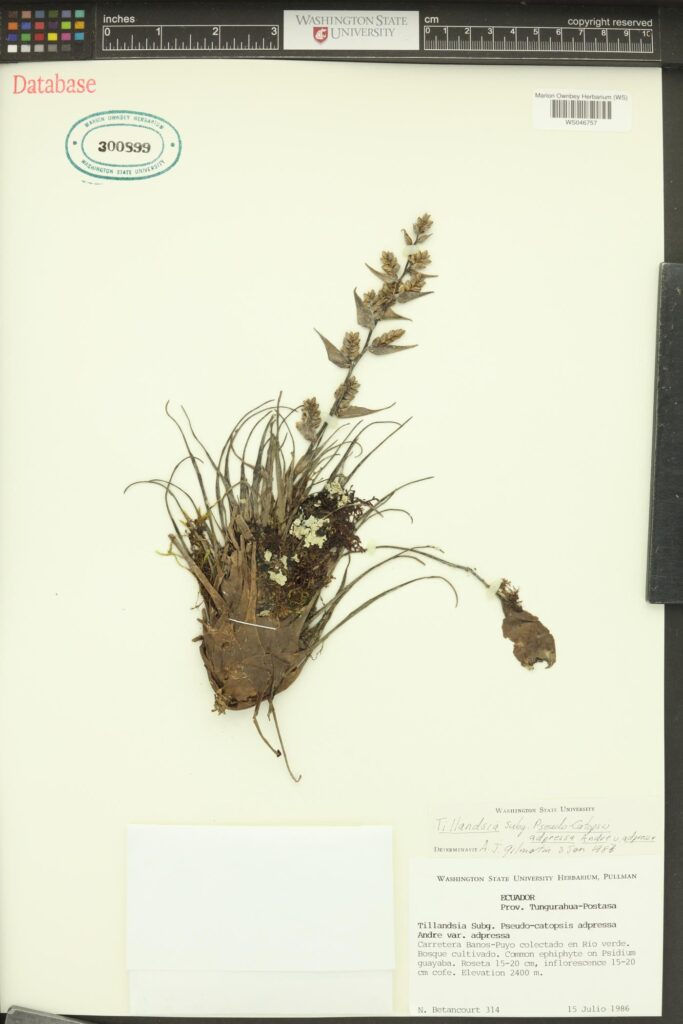
The bromeliad family (Bromeliaceae) has more than 2600 species and is largely restricted to the New World Tropics (with one native species in tropical West Africa). Only 19 species venture into the southern and southeastern United States, and none are native to Washington State. Nonetheless, the WSU Herbarium contains three full cabinets of bromeliads (with over 1000 specimens).
The reason for this anomaly is the work of Amy Jean Gilmartin, director of the Ownbey Herbarium from 1975 until her death in 1989. Gilmartin was an expert on the taxonomy of bromeliads (especially of Ecuador), but she and her students also studied genetic diversity of milkweeds (Asclepias), biscuitroots (Lomatium), and grasses. She was also an early proponent of computer databasing of herbarium specimen labels, well before this became common practice in herbaria.
Most bromeliad species are epiphytes that grow on the branches or trunks of trees or shrubs (occasionally even cacti). Unlike parasites (such as mistletoe), epiphytes do not extract water or nutrients from their host plants – they just use them as a platform to derive their own water and nutrition from the skies (another term for these species is “air plant”). The leaves of bromeliads are usually fleshy and arranged in an overlapping spiral, allowing water to accumulate in the spaces between the leaves. These so-called tanks can be mini arboreal wetland ecosystems containing insects, crabs, worms, amphibians, and aquatic plants. Some bromeliads, such as the “Spanish mosses” (Tillandsia), have specialized scale-like hairs on the outer leaf surface that increase the surface area for absorption of air-borne nutrients. Adpressed air plant (Tillandsia adpressa) is an epiphyte that ranges from Costa Rica to Peru. The specimen shown here nicely illustrates why species richness is so high in the tropics of Ecuador, where it was collected. This individual was found growing on a guava (a small tree in the myrtle family and source of the eponymous edible fruit) in a cultivated forest. Growing epiphytically on the bromeliad are another 2-3 species of mosses and liverworts and at least one foliose lichen! Amy Jean Gilmartin would have appreciated the conundrum of databasing 5 species on the same specimen! – Walter Fertig, 17 May 2025