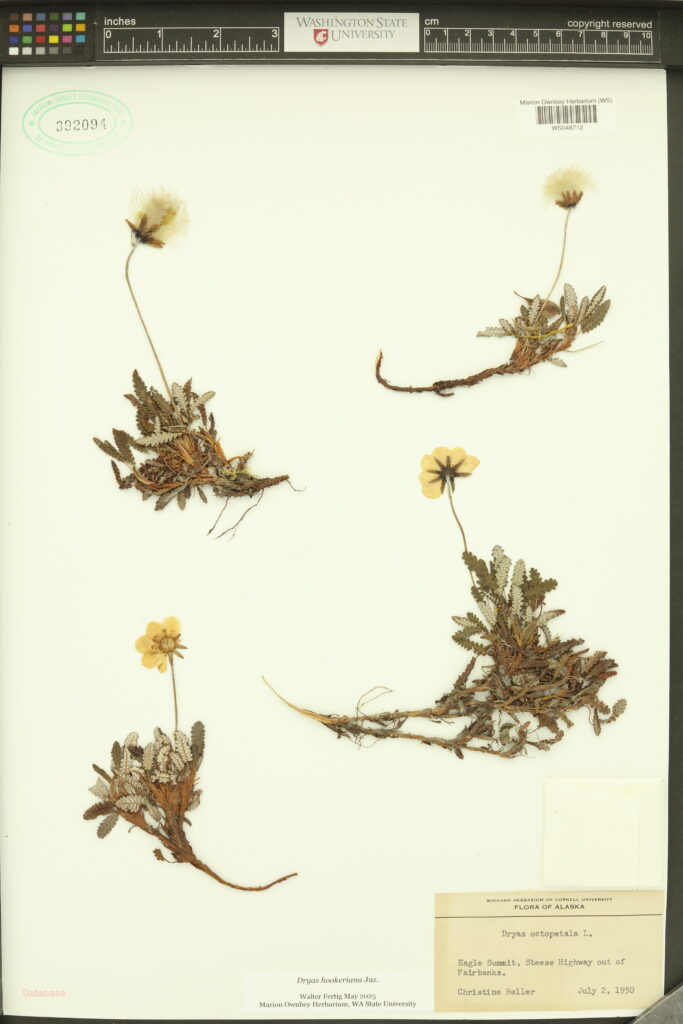
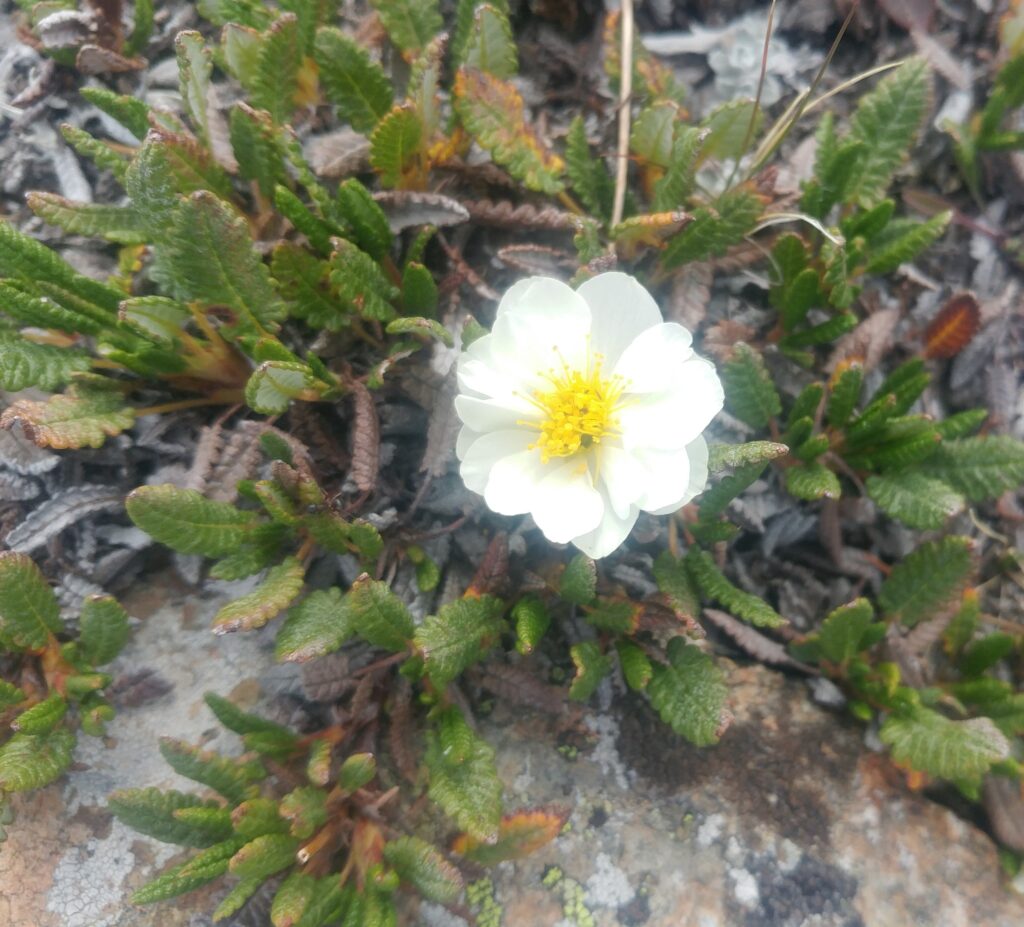
The genus Dryas in the rose family is comprised of 15 circumboreal species characterized by saucer-shaped flowers with 8-12 white or yellow petals, evergreen leaves with round-toothed margins and dense pubescence on the underside, and clusters of dry fruits capped by persistent feathery styles. The fruiting heads bear a strong resemblance to the Truffula trees of Dr. Seuss, or the wild hair of Troll Dolls. These hairs are utilized by the plant to disperse its one-seeded achene fruits by wind or trapped in the fur or feathers of passing animals.
Today, Dryas plants are largely restricted to cold environments of the arctic tundra, boreal riverbanks, and alpine meadows and fellfields of the higher peaks of the Rocky Mountains. Because these species are so morphologically distinct and so tied to cold environments, paleoecologists use Dryas fossils to reconstruct past climate events. Three periods of rapid cooling in the late Pleistocene are named the Oldest, Older, and Younger Dryas in recognition of the sudden appearance of fossil Dryas leaves and fruits in sediment cores in northern Europe and North America. The most recent of these (the Younger Dryas) occurred between 12,900 to 11,700 years before present and marked a rapid cooling of about 5 degrees F in Europe and North America over just a few decades (Greenland may have cooled by as much as 18 degrees F at the same time). This rapid cooling had significant global impacts on sea level and temperatures in the northern hemisphere, though the southern hemisphere apparently warmed up at the same time. The Younger Dryas was the last hurrah of extreme cold and ended abruptly with a warming trend that marked the end of the Pleistocene and beginning of our current, Holocene epoch.
The white-flowered Hooker’s dryas (Dryas hookeriana) is one of the more widespread Dryas species, ranging from Alaska south through the Rocky Mountains to Utah and Colorado. It is often a pioneer species in recently disturbed (including de-glaciated) rocky alpine areas. Dryas forms ectomycorrhizal associations with fungi and hosts nitrogen-fixing microbes in its roots which improves soil fertility. In Washington, yellow-flowered Drummond’s dryas (D. drummondii) occasionally occurs at lower elevations associated with limestone, such as the cliffs above the Pend Oreille River in northeastern Washington. – Walter Fertig, 17 June 2025