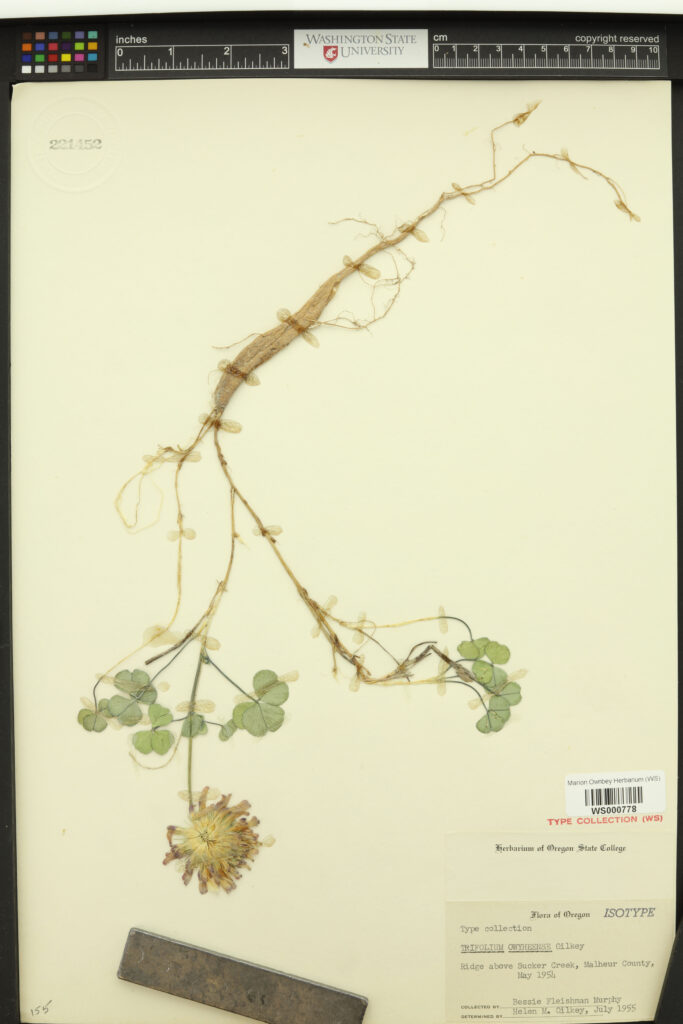
New plant species are still being discovered and named every year. Sometimes, a species avoids detection by taxonomists for many years because of its diminutive size or strong resemblance to another species. In other cases, species are overlooked because they are restricted to small geographic areas or highly specialized (and limited) habitats – species that are referred to as local endemics. Owyhee clover (Trifolium owyheense) belongs to the latter group, being limited to a small area in Malheur County, Oregon, and adjacent Owyhee County, Idaho and growing only on dry shaley slopes and diatomaceous earth. It is exceptional, however, in being quite showy, with enormous (for a clover), globe-shaped flower heads nearly 2 inches across, consisting of 20-30 pink to magenta flowers. Owyhee clover is listed as a sensitive species in both states, where it is known from about 40 sites.
Helen Gilkey, curator of the Oregon State University Herbarium from 1918-1951, described Owyhee clover as a new species in 1956. The type specimen was collected by Bessie Fleischman Murphy, of the OSU Seed Laboratory, from a “ridge above Sucker Creek”, described in Gilkey’s paper as a tributary of the Snake River in an area with blue-gray exposures of diatomaceous earth (formed from fossil marine algae).
Unfortunately, there is no Sucker Creek presently known from Malheur County, Oregon! In trying to map this specimen for the WSU digital database (hosted in SEINet at Consortium of Intermountain Herbaria Washington State University Marion Ownbey Herbarium) I did find a Succor Creek near other known populations of Owyhee clover, and a homophone of sorts for Sucker. Whether this small desert stream was originally named for a minnow-like fish, a plant sprouting from a root, or a gullible homesteader (all variants of the word ‘sucker’) and later renamed for providing relief (i.e. succor) is a matter for the historians or the U.S. Board on Geographic Names. Conservationists might find the badlands around Succor Creek of interest, however, as the site would represent a small range extension for this rare species.
Helen Gilkey was trained as a mycologist specializing on the taxonomy of truffles. She was also a skilled botanical illustrator, contributing original drawings to Willis Jepson’s 1925 Flora of California and other books and publications (including her paper describing Owyhee clover in the journal Madroño). Years after retirement, Gilkey co-authored the Handbook of Northwestern Plants with La Rea Dennis of OSU (in the Small World Department, La Rea was my undergraduate advisor at OSU back in the day!). Gilkey was also an outspoken proponent of women’s equality, environmental protection, and other social causes. – Walter Fertig, 8 July 2025