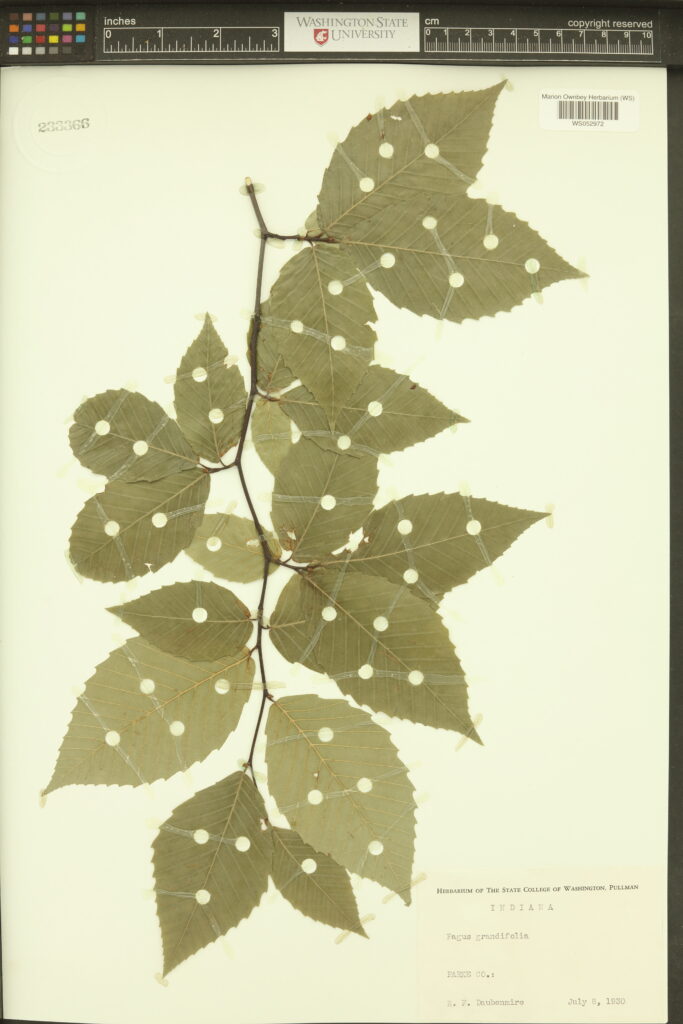
American beech (Fagus grandifolia) is the only member of the beech genus native to North America. It is abundant across much of the Eastern Deciduous Forest ecoregion of the eastern United States and southern Canada, ranging as far west as Wisconsin and Texas. Beech is in the same family (Fagaceae) as chestnuts (Castanea) and oaks (Quercus), differing from these two genera in having pairs of 3-sided nuts borne within a short-prickly involucre (easily mistaken for the fruit), stamen-bearing flowers in ball-like catkins, short-toothed leaves, and smooth, gray bark.
Unlike its relative, the American chestnut (Castanea dentata), beech has not been devastated by an introduced pathogen, like the chestnut blight fungus. Looking at this specimen, however, one might think it was attacked by some leaf-boring insect! Actually, the holes were purposefully made with a hole punch as part of the specimen mounting process. The anonymous person who prepared this specimen followed the “Archer Method” for adhering tree samples by applying a concoction of toluene, methanol, ethel cellulose, and Dow resin across the holes and leaf tips. This formula was initially developed by William Andrew Archer, curator of the US National Herbarium, in the 1950s and for a time was a popular method for mounting plant specimens. That is until the toxic properties of toluene became known! Fortunately, the Archer Method is no longer in wide use.
This specimen was collected by Rexford Daubenmire while he was an undergrad at Butler University. Daubenmire later became a prominent ecologist at the University of Idaho and then Washington State University, where he did important research on remnant Palouse Prairie plant communities and the theory of plant community succession. Daubenmire is also one of two* WSU ecologists to have a sampling protocol named after him (in this case the Daubenmire frame and Daubenmire plant cover scale). Daubenmire’s methods for standardizing the estimation of plant cover are still widely used by vegetation ecologists to this day. – Walter Fertig, 28 July 2025
*Robert Whittaker, known for the Whittaker plot, started his professional career at WSU in the late 1940s before moving to greater fame and fortune at UC-Irvine and Cornell. More on Whittaker in a future post!