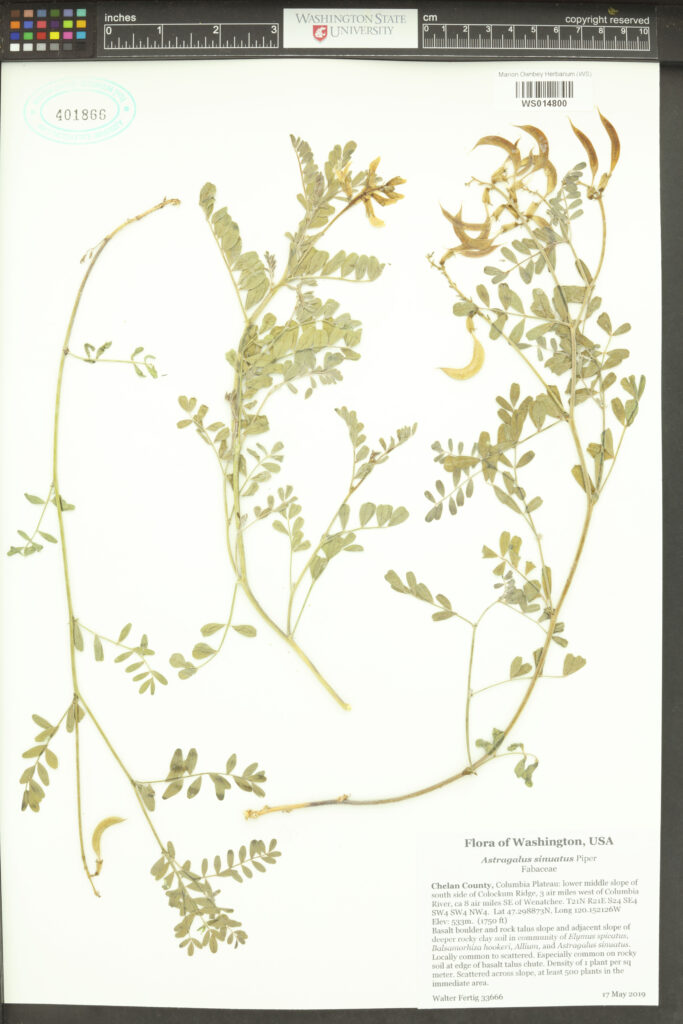
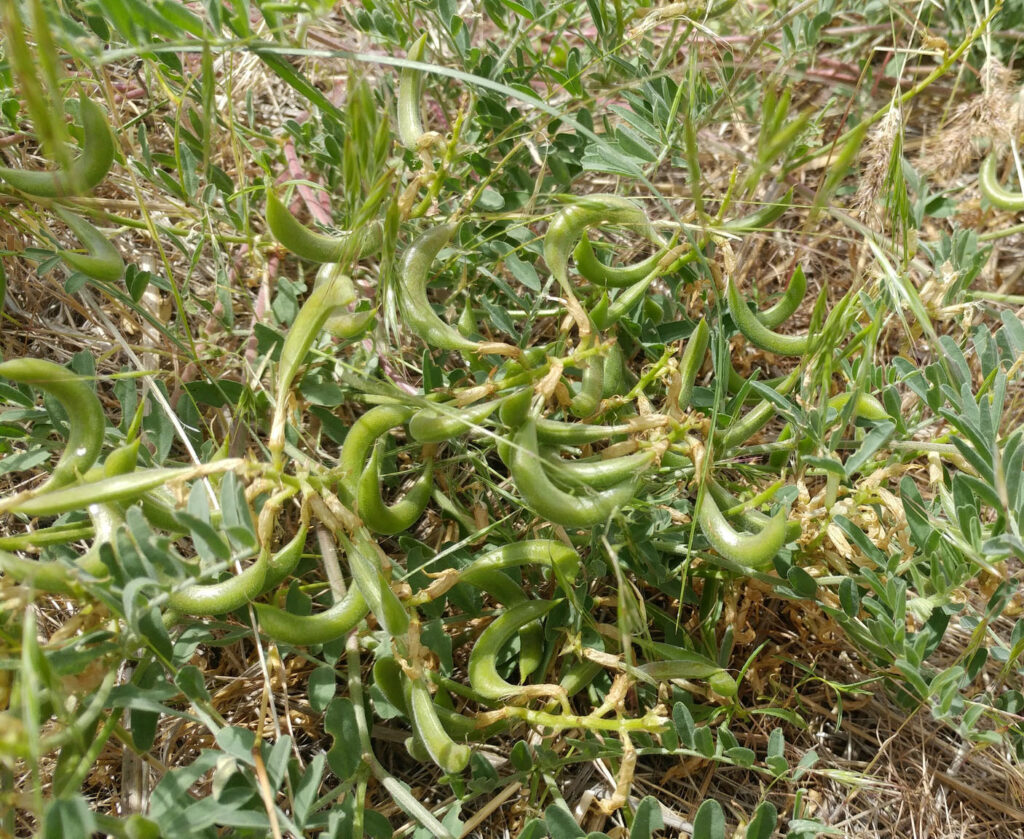
Charles Vancouver Piper (1867-1926) wrote the first flora of the state of Washington (1906) and was the first botanist on the faculty of the State College of Washington (now WSU), as well as the founder of the WSU Herbarium. In the course of his professional duties, Piper described many new species native to Washington, including a pair of milkvetches (pea family, Fabaceae) from the foothills south of Wenatchee. The first he named Astragalus sinuatus (for the wavy suture on the fruit pod) in a 1901 paper in the Bulletin of the Torrey Botanical Club. This species was based on a single, fruiting specimen collected by T.S. Brandegee in 1883 during a botanical survey of potential railroad lines in central Washington. Brandegee’s type specimen (housed at the Gray Herbarium in Harvard) unfortunately lacked any specific location data (as, unfortunately, was often the case in 19th century expeditions). The following year, Piper published another new species, called Astragalus whitedii for its collector, Kirk Whited, who found a distinctive, white-flowered milkvetch with broad leaves and stipitate (though immature) fruits in the hills above Colockum Creek.
While writing the state flora a few years later, Piper realized that sinuatus and whitedii were actually one and the same species. Since sinuatus was published first, it had priority over whitedii and became the accepted name. Piper, however, decided to rename the species Phaca sinuata in his statewide flora, choosing to split the very large genus Astragalus into smaller segregate genera. Per Axel Rydberg, an expert on the flora of North America from the New York Botanical Garden, took the splitting even further in a 1924 paper, recognizing both species as separate in yet another pea genus, Homalobus. It was not until 1961 that Astragalus sinuatus was recognized as the single, correct name for the species!
For years, this species retained the common name “Whited’s milkvetch” despite “whitedii” being a synonym, and not especially informative about the appearance or distribution of the plant. In 2019, Dave Wilderman of the Washington Natural Areas Program and I proposed “Colockum milkvetch” as a more meaningful name, describing its narrow range on the rocky, sagebrush ridges north of Colockum Creek in southern Chelan County. Most of the habitat of this rare species is protected by a Washington Department of Natural Resources preserve, though the species remains vulnerable to disturbance from periodic wildfires and competition from invasive annual grasses. – Walter Fertig 5 October 2025