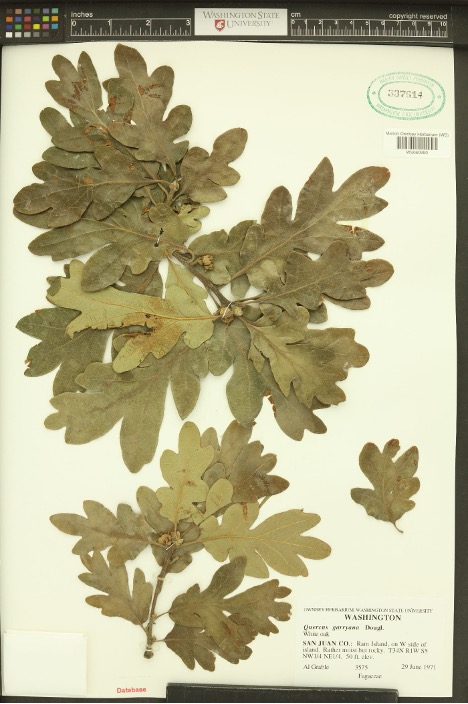
Oaks (genus Quercus), part of the beech family (Fagaceae), are one of the most evolutionarily successful groups in the Northern Hemisphere, boasting some 500 species and holding keystone roles in dozens of ecotypes. But from the vantage point of Washington State University, it can be easy to miss that, as there are no oaks native to the Palouse area. If you extend your view to the whole state of Washington, the number of native oaks increases to one: Garry oak (Quercus garryana), also frequently called Oregon white oak for its prominence one state to the south.
Garry oak ranges as far north as southwestern British Columbia in Canada, where it is also the only native oak, and as far south as Los Angeles County in California. Mature trees can reach heights of 50-90 ft (15-27 m). Garry oaks can tolerate diverse climates, including flooding and drought conditions, and appear in both pure stands and mixed forest cover with conifers or other broadleaf species. Like other members of the genus, Garry oaks display deciduous and deeply lobed leaves, catkin flowers, and acorns that provided an abundant food source to wildlife and Indigenous populations. The bark is gray and deeply fissured, while the leaves have a leathery, shiny texture.
Garry oak is named after Nicholas Garry, who served as deputy governor of the Hudson’s Bay Company (HBC) in the early to mid-1800s. Garry was not a botanist, but rather a merchant who embarked on naval expeditions to manage HBC trading outposts along the coast of western North America. One of these expeditions did include a botanist, David Douglas (1799-1834). Charged with making collections on behalf of the Royal Horticultural Society, Douglas cataloged and named dozens of species on this trip, and presumably coined Garry oak to honor the financier of his vessel.
Douglas is remembered today for his extensive botanical contributions, as well as becoming the namesake of the Douglas-fir (Pseudotsuga menziesii). Garry’s name was also lent to a Canadian trading outpost, which later formed the basis for the modern city of Winnipeg. Meanwhile, the legacy of the HBC lies in their transition from fur trading to retail and department stores, and as of 2025, being liquidated. – Henry Landis, 16 October 2025