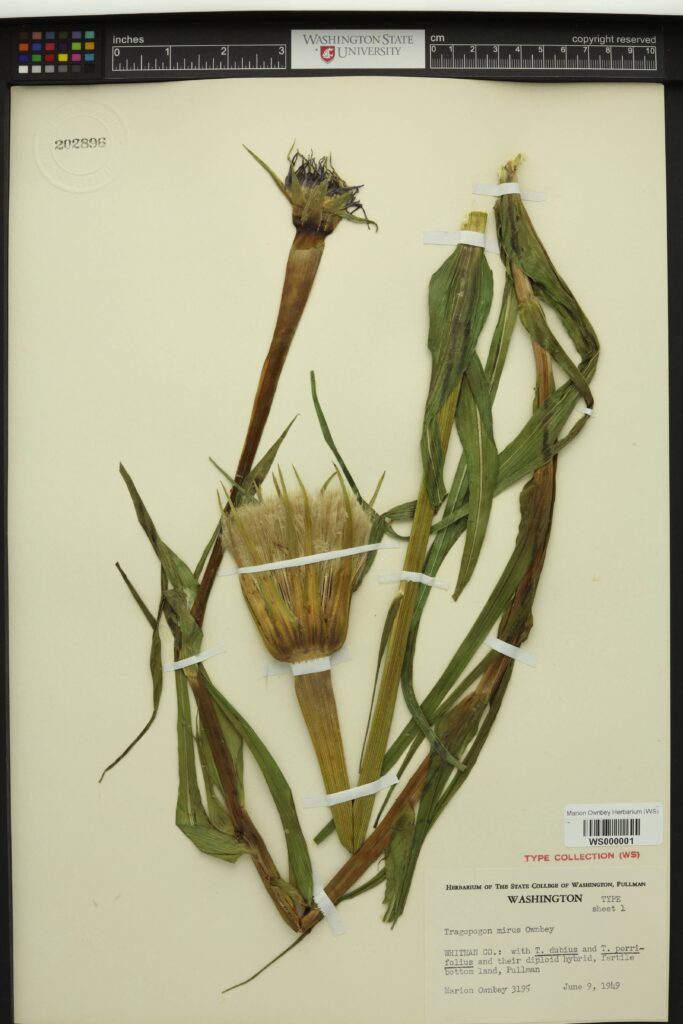
If two plant species native to Europe are introduced to North America and then hybridize to produce fertile offspring, do these descendants constitute a new species? That is the question Marion Ownbey posed in a 1950 paper in the American Journal of Botany. Ownbey, curator of the Washington State University herbarium from 1939-1974, discovered that three Old World species in the genus Tragopogon (goatsbeard or salsify) that were introduced to the Palouse grasslands of SE Washington and Idaho in the late 1800s could hybridize with each other. Not only that, but these promiscuous composites produced not one, but two new species! This was the first time that rapid speciation through hybridization was demonstrated in nature. And the reason Ownbey’s name was given to the WSU herbarium.
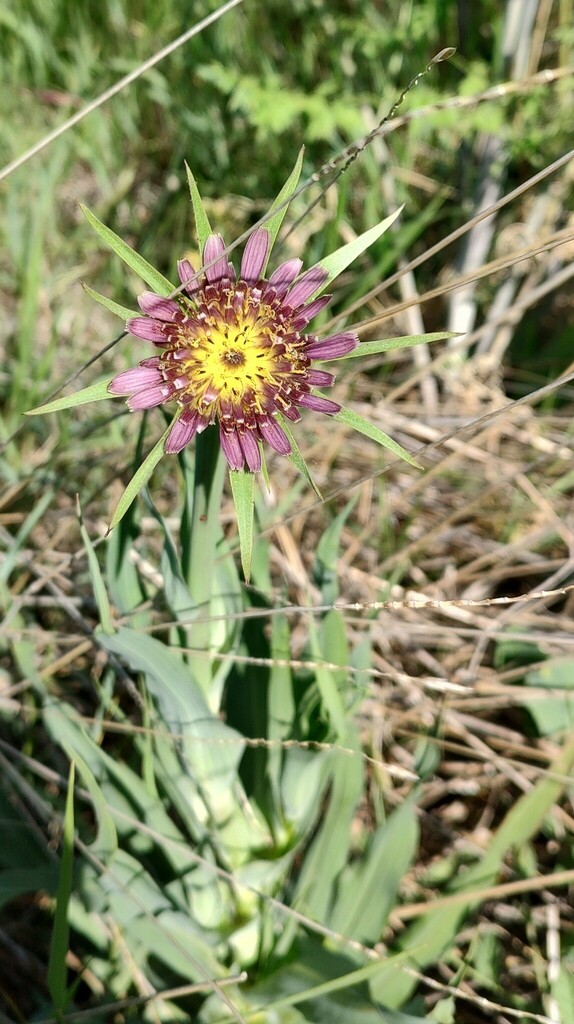
Remarkable goatsbeard (Tragopogon mirus) is one of the hybrid species Ownbey named. This species has purple-tipped ligulate flowers, like its parent, oyster-plant (T. porrifolius), but a yellow “eye” at the base of these same flowers and curved, slightly woolly leaves, like its other parent, yellow salsify (T. dubius). Through meticulous chromosome analysis and years of experimental crossing, Ownbey showed that these two diploid species could readily hybridize in nature and the greenhouse, though most of the offspring were sterile. At four sites, however, Ownbey discovered hybrid plants that had doubled their chromosome count to become tetraploids and thus were self-fertile, but not able to produce viable offspring in back-crosses with their diploid parents. More recent studies have demonstrated that these rare hybridization and chromosome doubling events have occurred multiple times. Today, Remarkable goatsbeard is relatively common in Pullman, where it still grows with its two parents. Another hybrid species, Ownbey’s goatsbeard (T. miscellus), is also found in the Pullman-Moscow area (and beyond). It was derived from numerous hybridization and chromosome doubling events between yellow salsify and meadow salsify (T. pratensis).
Carolus Linneaus, originator of the system taxonomists follow for naming species, was the first to demonstrate that hybridization could occur between European populations of Tragopogon porrifolius and T. pratensis in 1759. Ironically, no new species have derived from these two parental taxa, either in Europe or North America. (At least not yet.) Our two new Tragopogon species occur in human-altered landscapes along roadsides and agricultural fields. Although their parents all emigrated to North America, the first-generation descendants were all born here. Under the concept of birthright citizenship, these new species should be considered “native”! While they may not be of the same conservation concern as rare native plants, they certainly are of exceptional scientific interest for demonstrating evolution in action – Walter Fertig 5 December 2025