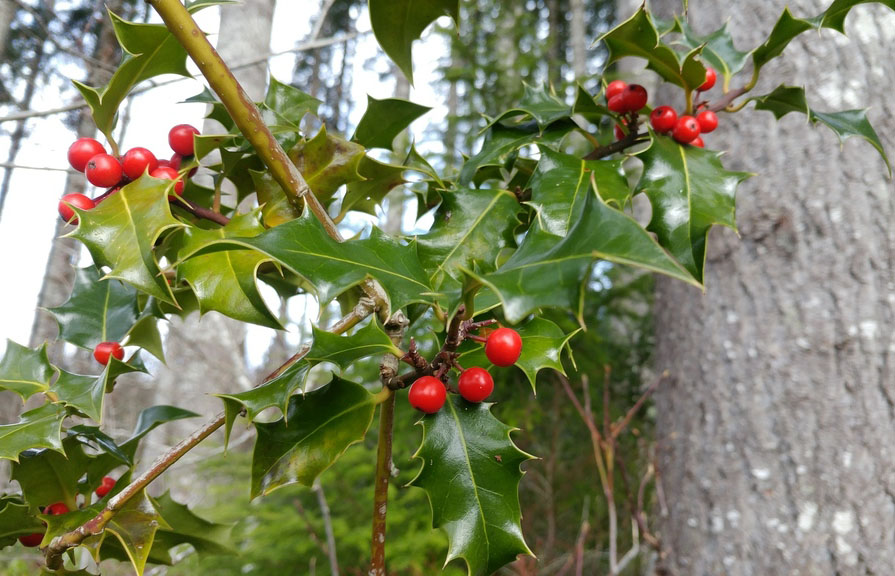
Humans have been brightening their otherwise dark and dreary December domiciles with evergreen boughs of holly since at least the age of the Druids. The practice has continued into the modern era, with the festive shiny green leaves and bright red berry-like fruits (botanically-speaking a drupe with four hardened stones) becoming synonymous with the Christmas season.
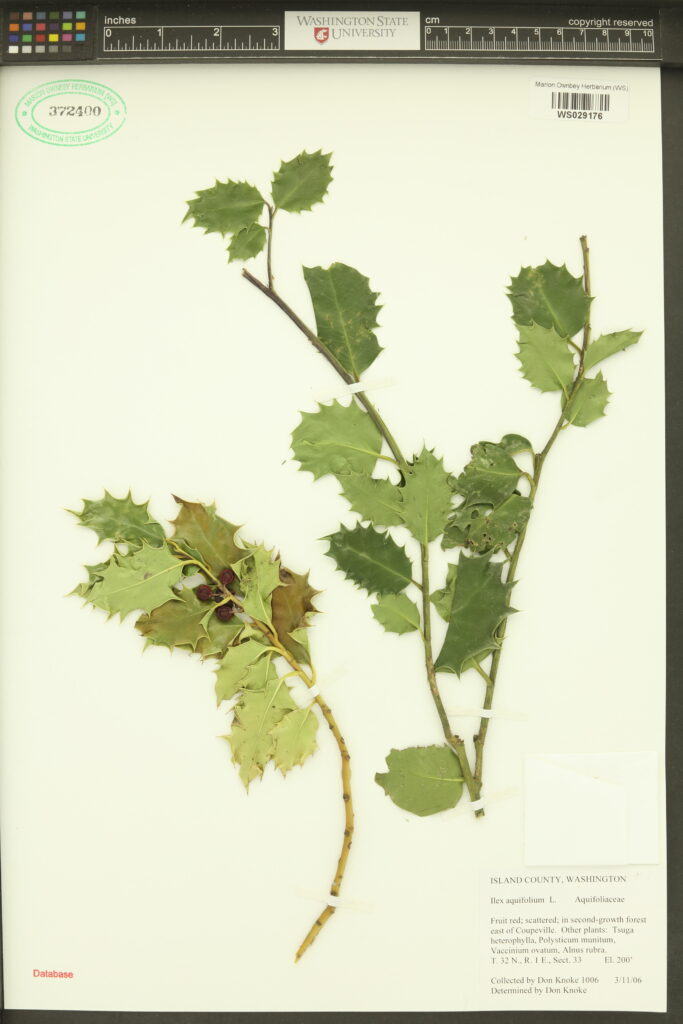
There are more than 400 species of holly found throughout the world, though most abundantly in tropical and temperate regions of Asia. English holly (Ilex aquifolium) is the most widely cultivated species and the most in-demand for yuletide ornamentation. The Latin epithet aquifolium literally translates as “spiny leaf” which accurately describes the form associated with Christmas time. English hollies can also have entire leaves without spines – and a single tree may sport both spiny and non-spiny leaves on the same branch. Plant breeders have also developed forms of holly with green and white or yellow variegated leaves.
Although there is a native North American holly (I. opaca) that closely resembles its English cousin, enterprising businesspeople in Washington and Oregon brought I. aquifolium into cultivation for the holiday market. Unfortunately, English holly has escaped into the wild and become a nuisance species in the lowland forests west of the Cascades. Holly wood (not to be confused with Tinseltown, California) is exceptionally dense and easily dulls a chainsaw, making the species unpopular with silviculturists. Like animals, hollies are dioecious, producing separate staminate (pollen-producing ‘male’) and pistillate (seed-bearing ‘female’) flowers on separate individuals. One would assume that the ratio of male to female plants would be 1:1, but in fact, staminate plants are often far more common than drupe-producing pistillate trees. This anomaly results from male trees being able to invest more of their photosynthetic energy into growth and production of asexual clones (genetically identical individuals connected underground by their roots). Female trees, by contrast, spend more energy producing seeds and fruit, leaving less for growth or asexual reproduction. The added strain of motherhood also results in pistillate individuals being shorter-lived. – Walter Fertig 22 December 2025