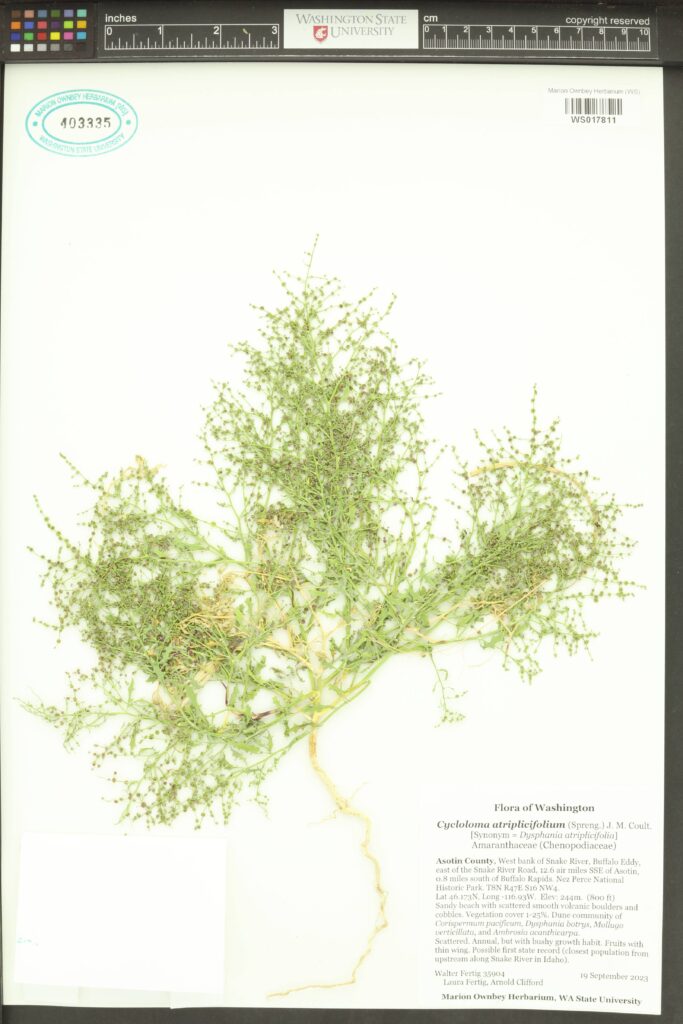
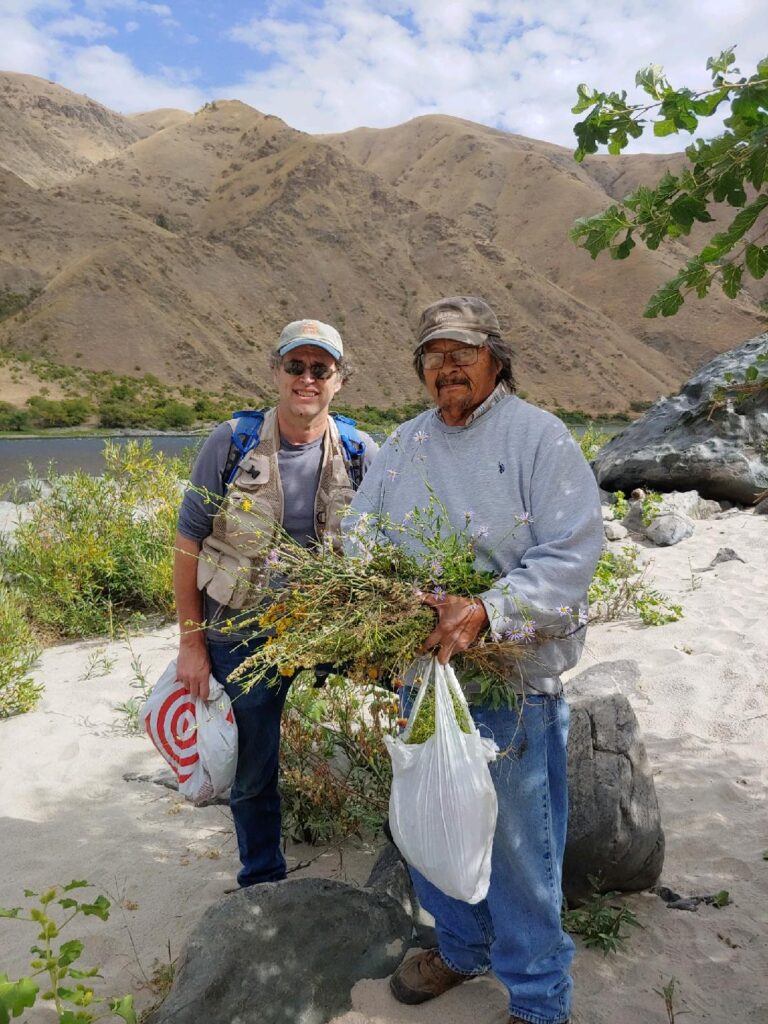
In September 2023, my wife Laura and I were botanizing along the Snake River in southern Asotin County, Washington with Arnold Clifford, a Diné botanist and geologist visiting Pullman from Beclabito, New Mexico. As we were walking along the sandy beach, Arnold and I noticed a loosely ball-shaped herb with narrow, toothed leaves and tiny, greenish fruits, each encircled by a thin, wavy wing resembling the tutu of a ballerina. Being accustomed to the flora of the Four Corners region of the United States, Arnold and I both recognized the plant as winged pigweed (Cycloloma atriplicifolium), a member of the chenopod family (now lumped in Amaranthaceae) that is common in sandy areas of the southwest. We each collected a sample for our respective herbaria (one for the Carrizo Mountain Herbarium on the Navajo Reservation, and one for the Ownbey Herbarium at WSU) and moved on to find other interesting plants around the bend.
Later that evening as I pressed my specimen it occurred to me that I had not seen Cycloloma before in Washington. Consulting my well-worn copy of Flora of the Pacific Northwest, I was surprised to discover that this species was not known from the state, though it approached Washington in the Hells Canyon area of Idaho (upstream on the Snake River) and in southwestern British Columbia. After checking iNaturalist, the Burke Herbarium Image Collection website, and other online databases, I was able to confirm that our collection was the first for Washington – a state record.
Winged pigweed (also known as Dysphania atriplicifolia based on recent molecular research) is native to the central and southern portions of North America, but considered introduced in Washington and the Pacific Northwest. How do botanists determine whether a plant is native though? Often, this is based on the known range of a species, derived from decades of past collecting. Since winged pigweed was not known in the Northwest before 1997, it seems reasonable to assume it is introduced in our area. But having winged fruits, this species can disperse easily by wind or possibly even water (a second Washington population was found downstream on the Snake near Clarkston, WA, by botanist Jeff Walker in 2025). If winged pigweed is migrating to new areas on its own (without human assistance) perhaps it should be considered part of our native flora. – Walter Fertig, 21 February 2026