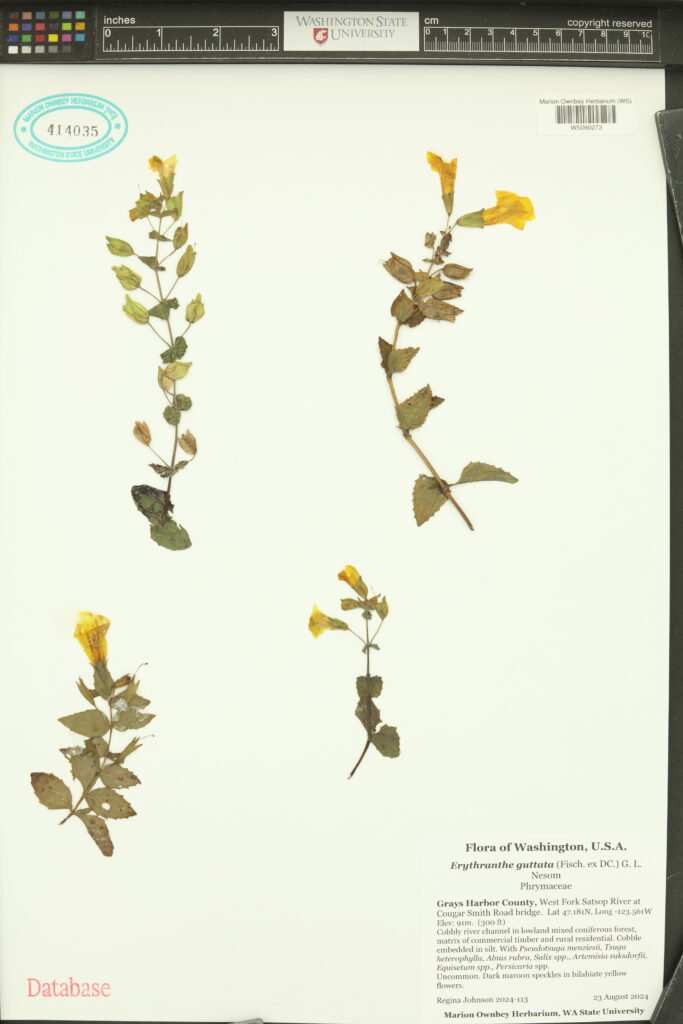
Model organisms play a central role in guiding scientific inquiry. Because we lack the resources to exhaustively study every aspect of all species, we designate a small selection as “models,” on the assumption that discoveries in our models can be applied to non-models. This assumption holds because all life has a common ancestor, and therefore some degree of genetic similarity. That same assumption underlies systematics, our ability to classify biodiversity. Much like life, however, classifications are subject to change. Sometimes, this means reclassifying our models.
Yellow monkeyflower has long been known by the scientific name Mimulus guttatus, codified in 1813 by Swiss botanist Augustin Pyramus de Candolle. It grows in wet locations like the edges of streams and pools, or in moist meadows. The epithet guttatus, Latin for “spotted,” refers to the red-brown spots on the inside of the bright yellow petals, which attract bee pollinators. The variability in form and lifecycle ascribed to M. guttatus is exceptional: populations of annuals and perennials, diploids and tetraploids, inbreeding and outcrossing, plants a few inches high to sprawling clumps several feet wide, have all been documented. This flexibility leads to the reputation of M. guttatus as a species complex, with boundaries between varieties and full species unclear. In fact, the complex contains many species that had been described in the late 1800s to early 1900s and later lumped under M. guttatus. Arthur Cronquist prominently advocated for this lumping in the first edition of Flora of the Pacific Northwest.
That same diversity is why the M. guttatus complex, and the genus Mimulus as a whole, makes a useful model. Since so much genetic material is shared across the complex, we can more confidently identify genetic changes contributing to high diversity and subsequently extend those findings to other taxa. The record of discoveries attributed to Mimulus studies, and especially to M. guttatus, is extensive. Some argue that the name Mimulus should be protected, to avoid confusion among present-day researchers.
The tide of taxonomic change is overcoming inertia, however. In 2012, a group of taxonomists led by Guy L. Nesom proposed to split Mimulus, which had been determined via molecular data as paraphyletic, into numerous smaller genera. M. guttatus was transferred to the genus Erythranthe, becoming E. guttata. Many species that had been lumped into M. guttatus were also resurrected under Erythranthe, with the purpose of separating annual populations from perennials, diploids from tetraploids, and so on. Most major floras have adopted the newer circumscriptions. Despite this wider acceptance, many new academic articles persist in using the older, unsplit Mimulus names. The tension reflects a fundamental, not easily addressed, question of taxonomy: how best to know the things we know? – Henry Landis, 20 February 2026