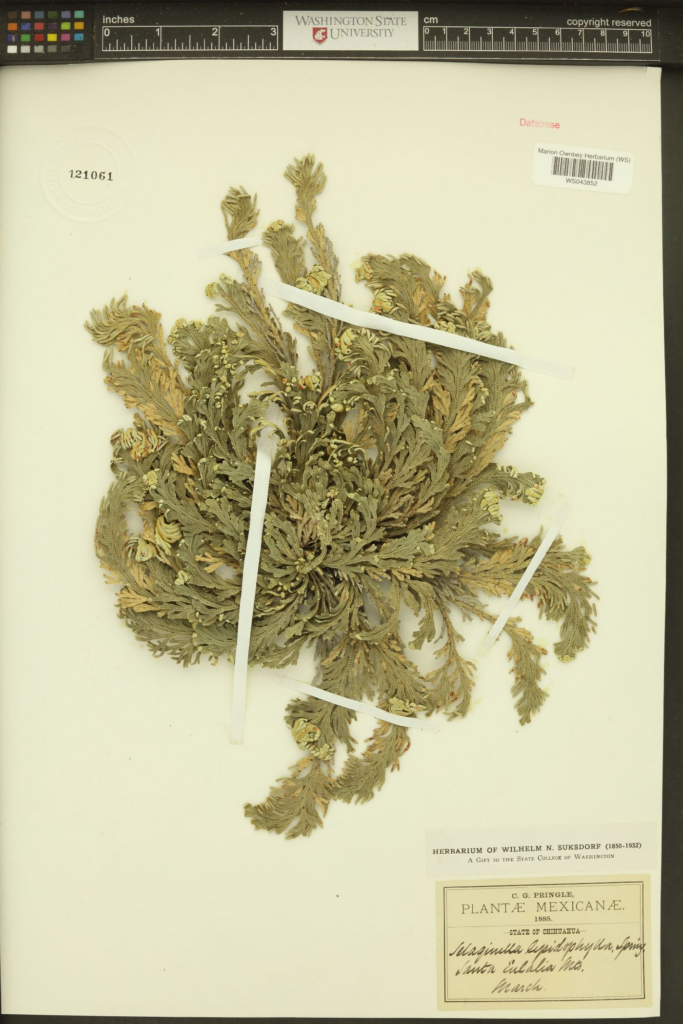
With their high temperatures and low precipitation, deserts are a tough environment for most plants to survive. Those species that do persist employ one of three strategies. Annuals evade drought by germinating, flowering, and setting seeds in a narrow window of suitable soil moisture in early spring, surviving unfavorable periods as drought-hardy seeds in the soil. Stem succulents, like cactus, or plants with deep-seated roots like mesquite (Prosopis) can avoid drought conditions by storing water within their own tissues or growing in specialized habitats where deep soil water is available, such as arroyos. Finally, a few perennial plants are drought tolerators that become dormant during periods of extreme heat and moisture deficits, reviving quickly following rare rainfall events.
Resurrection plant or desert scale-leaf spikemoss (Selaginella lepidophylla) is a spore-bearing vascular plant from the deserts of the southwestern US and northern Mexico that is one of the drought tolerators. Most of the year, resurrection plants appear dead, with their leaves all brown and curled tightly in a ball. Once soaked by rain, this species begins to green up almost immediately. Although they may have lost 97% of their internal moisture, Selaginella leaf cells suffer little permanent damage during their prolonged period of dormancy. First, the plants begin respiring and using stored food reserves to rebuild their chloroplasts and the enzymes needed for photosynthesis. Then within a few hours, they are able to once again create their own food from sunshine, carbon dioxide, and water – literally returning from the dead. But they must do this quickly, as extreme heat dries them out again, and the plants return to their previous state of inactivity. Resurrection plants must then wait for the next rainfall event, which may be months or years in the future. The specimen shown here was collected in northern Mexico by Vermont botanist Cyrus Pringle in 1885. Pringle was a horticulturalist known from breeding new varieties of potatoes as well as a professional plant collector, employed by the Smithsonian and Harvard’s Gary Herbarium to collect specimens from the American southwest and Mexico in the late 1800s and early 1900s. Pringle embarked on 39 collecting expeditions and gathered more than 500,000 specimens, representing at least 1200 new species to science during his sojourns in the southwest, often traveling by horse-drawn wagon. He was also a devout Quaker and notable pacificist in the Civil War who was imprisoned for refusing to serve in the Union Army until personally pardoned by Abraham Lincoln. Pringle remained an active field botanist well into his seventies, and was even planning a collecting trip to South America when he died at age 73 in 1911. – Walter Fertig 5 April 2026