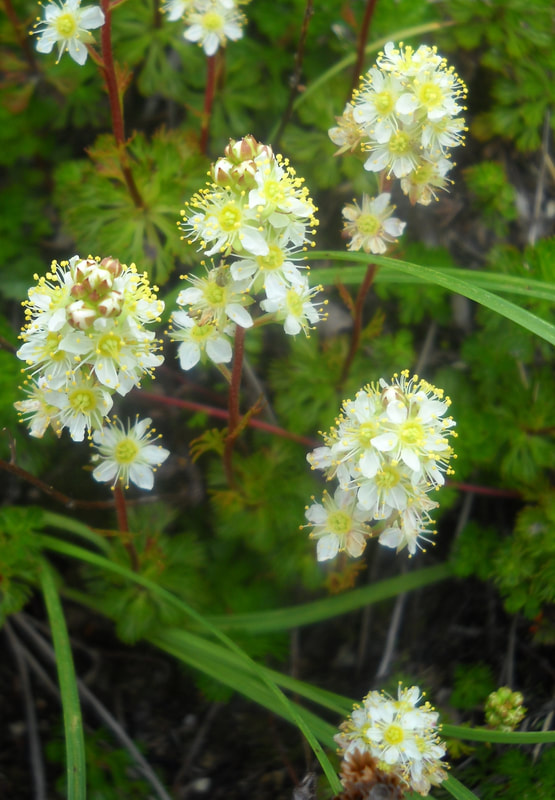
Partridge-foot gets its common name from its distinctive slender, wedge-shaped leaves which branch in threes, like the front toes of the eponymous game bird. The leaves may form dense mats, or be more widely spaced along a woody rhizome. These white-flowered plants are only 4-6 inches tall, but are technically shrubs because of their woody stems. Botanists describe such plants as subshrubs or semi-shrubs, to distinguish them from taller shrubs. The low, matted growth habit is an adaptation to deep snow and strong winds at or above treeline, where partridge-foot grows in the Rocky Mountains from Alaska to Montana, and the Coast and Cascade ranges from British Columbia to northern California.
Taxonomists were initially befuddled by how to classify partridge-foot. Frederick Pursh provided the first scientific name, but mistakenly thought it was a saxifrage (Saxifragaceae). John Torrey and Asa Gray correctly deduced that partridge-foot was in the rose family (Rosaceae), but thought it was a dwarf Spiraea. German botanist Otto Kuntze recognized it as its own genus, which he named after Russian sea captain and explorer Frederich Lütke, who mapped the coastline of Alaska in the 19th Century. Luetkea pectinata (pectinate – for the slender, tooth-like leaf segments) is the only species in the genus.
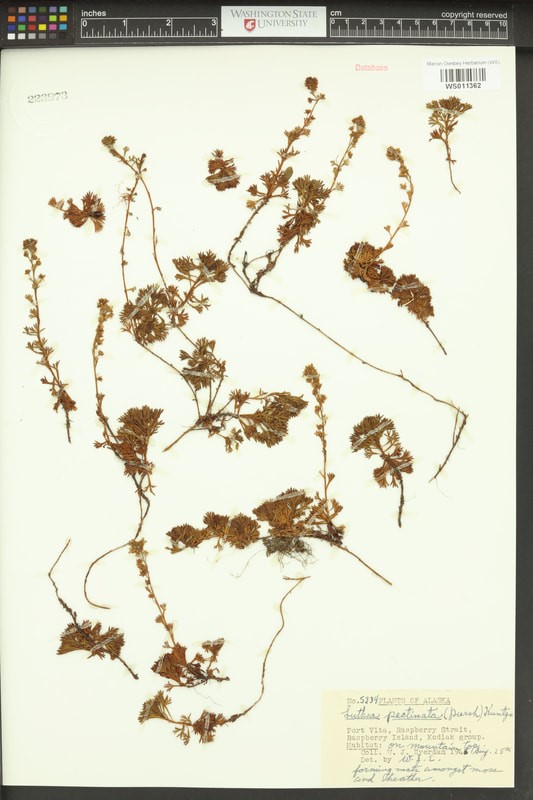
The specimen shown here is one of hundreds in the Ownbey Herbarium collected by Seattle native Walter J. Eyerdam (1892-1974). Eyerdam was a professional specimen collector for major museums, like the Smithsonian Institution in Washington, D.C., American Museum of Natural History in New York City, and the Field Museum in Chicago, specializing in mollusks, marine birds and mammals, vascular plants, and bryophytes. – Walter Fertig, 11 November 2024