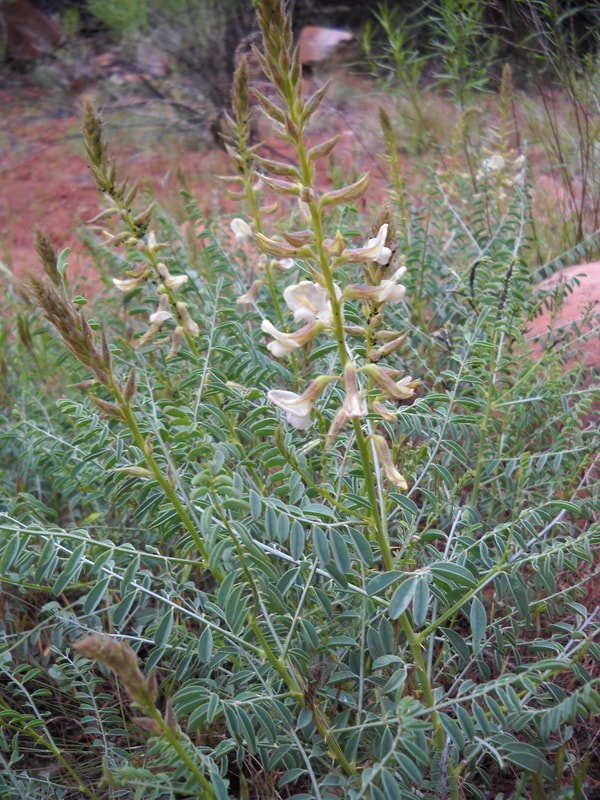
One of the mysteries of plant evolution is why some genera are incredibly species rich, while closely related ones contain just a few species. A case in point is Astragalus (commonly known as milkvetch or locoweed) which contains over 3200 species on every continent except Australia, and its cousin Peteria (sometimes called spiny milkvetch) with just 4 species in Mexico and the southwestern United States. These two genera in the pea family (Fabaceae) have similar growth forms and flower morphology, differing primarily in their stipules (those little flaps of green or membranous tissue at the base of each leaf) which are modified into sharp, needle-like spines in Peteria. Astragalus has been wildly successful in diversifying (it is considered the most species-rich genus worldwide and in western North America) in part due to its ability to specialize in unusual soil types and habitats. Perhaps the success of Astragalus has hindered the ability of its close relatives to compete and diversify in these same areas. And perhaps in a parallel universe (or if we had a do-over of evolution on Earth) Peteria would have thousands of species and Astragalus just a handful.
Not that Peteria is not a success in its own right! Peteria thompsoniae, shown here, occurs in pinyon and juniper woodlands and scrublands in dry washes, sandy flats, and rocky slopes over much of the southern Great Basin and Colorado Plateau, from eastern California and southern Nevada to southern Utah and northern Arizona. Disjunct populations also occur on volcanic sands associated with thermal areas in southern Idaho. The genus name honors Robert Peter, who was a 19th-century botanist best known for his contributions to the flora of Kentucky (and who probably never saw his namesake plant in the field). The species epithet commemorates Ellen Powell Thompson, sister of famed explorer John Wesley Powell, and an amateur botanist. She was married to geographer and university professor Almon Thompson, John Wesley Powell’s second in command on surveys of the Colorado River drainage in 1872. The mapping party was stationed north of Kanab, Utah, and Ellen spent a lot of time botanizing the local area. Ellen corresponded regularly with Sereno Watson of Harvard University, sending him packets of plant specimens from this botanically rich but under-collected region. She discovered at least 16 new species previously undescribed in the scientific literature, of which five were named for her (using her married name) by Watson. One of these happened to be an Astragalus (now known as A. mollissimus var. thompsoniae).
In later years, Ellen Powell Thompson became a prominent suffragette in Washington D.C. Unfortunately, she died a decade before the 19th Amendment was ratified, ensuring women the right to vote. For more on the life and legacy of Ellen Powell Thompson, check out the entertaining blog “In the Company of Plants and Rocks” by Hollis Marriott – Walter Fertig 4 December 2024