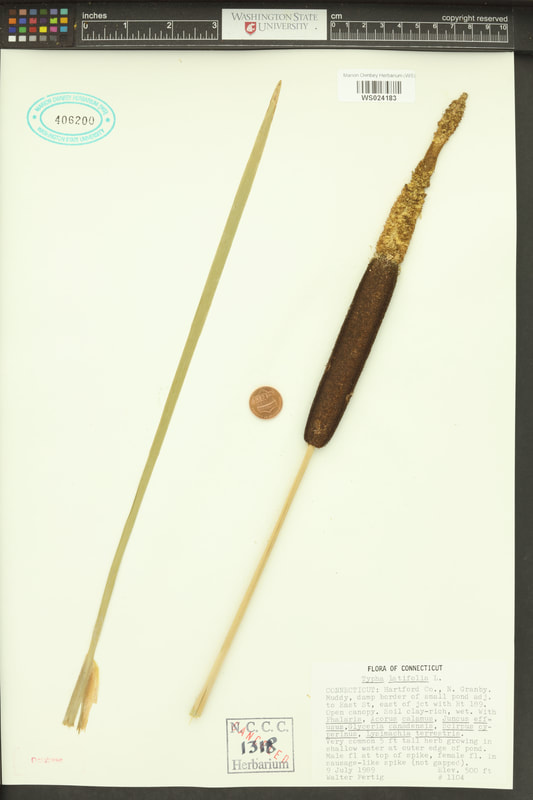
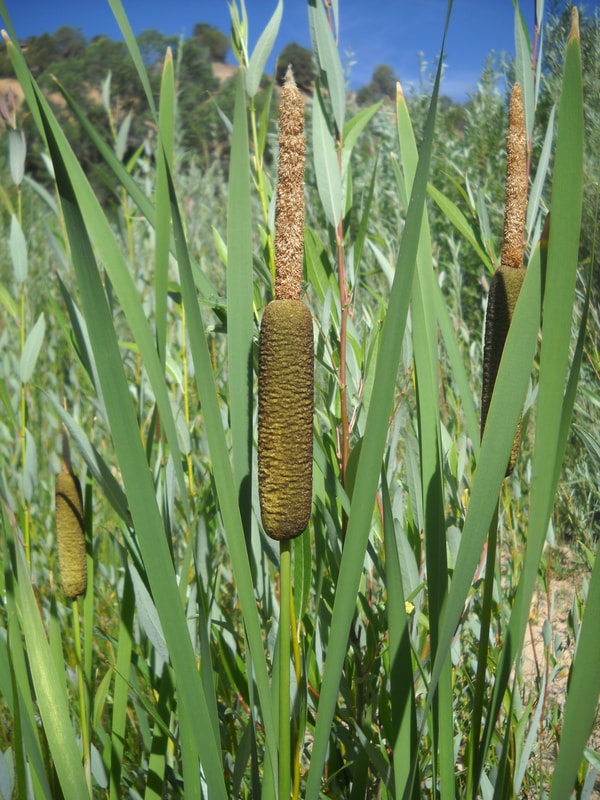
Wild food advocate, author, and Grape Nuts cereal pitchman Euell Gibbons described broad-leaved cattail (Typha latifolia) as the “supermarket of the swamps” in a series of popular books in the 1960s and 70s. Nearly every part of the cattail is edible or useful to humans. Yellow, pollen-bearing staminate flowers atop the flowering stalk provide a protein-rich pancake or cornbread flour. The thick spike of brown pistillate (female) flowers can be boiled and eaten like corn on the cob. Peeled stalks can be eaten raw or cooked and, according to Gibbons, are a “treat not unlike cucumber”. Lastly, starchy roots and rhizomes can be consumed like potatoes. Cattail leaves are used to construct baskets, floormats, and rush-seats for furniture. The fluffy hairs associated with cattail fruits are an effective insulator (akin to down in jackets or blankets) and when dry an excellent tinder to start a campfire.
Cattails are also an important source of food and shelter for wildlife. Cattail marshes provide habitat for aquatic insects, spawning areas for fish, nesting material for wetland birds, and hiding cover for waterfowl and deer. Beavers and muskrats are especially fond of cattail stems for food. Ecologically, cattails are significant in removing pollutants from water and contributing organic matter to soil.
Broad-leaved cattail is one of two native Typha species in North America. European settlers brought a third species, narrowleaf cattail (T. angustifolia), which has since spread over much of the continent. Narrowleaf cattail often forms dense monocultures that crowd out other desirable wetland plants. It also hybridizes with both native species, and the hybrids can be aggressive invaders. Broad-leaved cattail can usually be distinguished by the staminate spikes being directly above the pistillate spike, whereas narrowleaf and hybrid cattails have a gap between the two spikes. Technical features of the female inflorescence however, (such as the shape and presence of tiny sterile bracts within the spike), are needed for reliable identification.
Cattails are a challenge to prepare as herbarium specimens because their thick flower spikes have a tendency to explode when mature into a mass of cottony fluff (all the better to disperse tiny seeds by the wind). Each pistillate spike may have as many as 25,000 seeds tightly packed together. I have had more than one cattail inflorescence burst while preparing a specimen, and can attest that getting all those little seeds back into a flower spike is impossible! – Walter Fertig, 2 February 2025