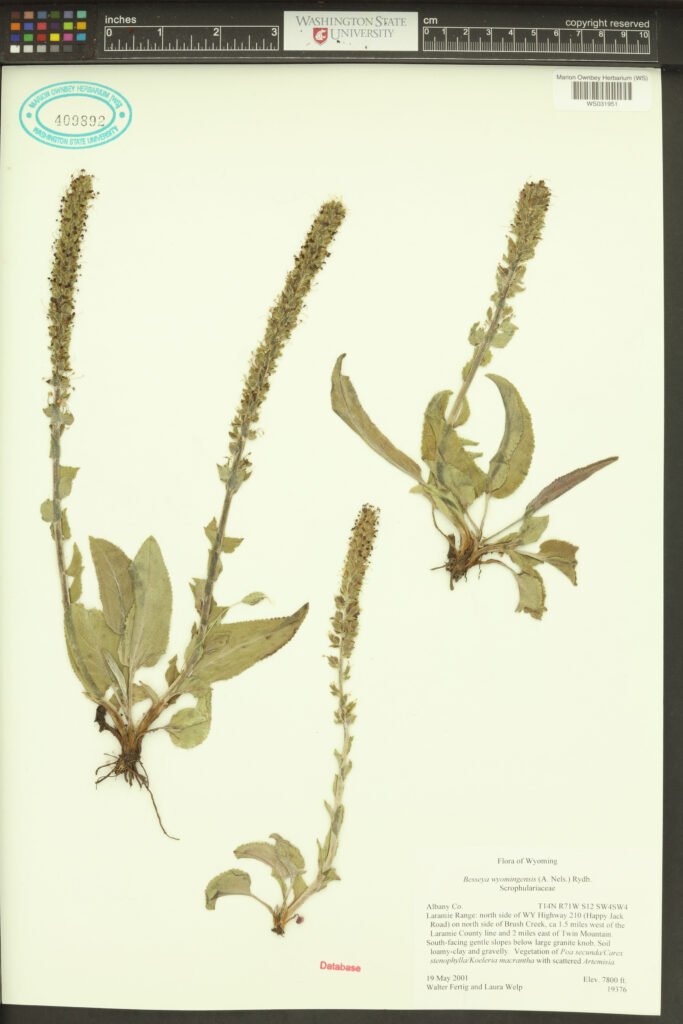
One of the things non-taxonomists find most frustrating about taxonomists is their propensity for changing species names. A case in point is Wyoming kittentails, a relatively common perennial herb in the Plantain family (Plantaginaceae – though until recently included in the figwort family, Scrophulariaceae, but that is another story!) with an elongate spike of bluish-purple or white flowers which lack petals. The floral color is derived entirely from the stamens (both the anthers and their filaments) which are well-exserted beyond a pair of green sepals. This species was originally named Wulfenia wyomingensis by Aven Nelson in 1898. It was transferred to Synthyris by Amos Heller in 1900, and then to the new genus Besseya by Per Axel Rydberg in 1903. Traditionally, Besseya species were recognized by their small (or absent) corollas and entire leaves, while Synthyris species had larger, more showy flowers and deeply lobed leaves. Both genera are closely related to Veronica and all have flattened, heart-shaped fruits.
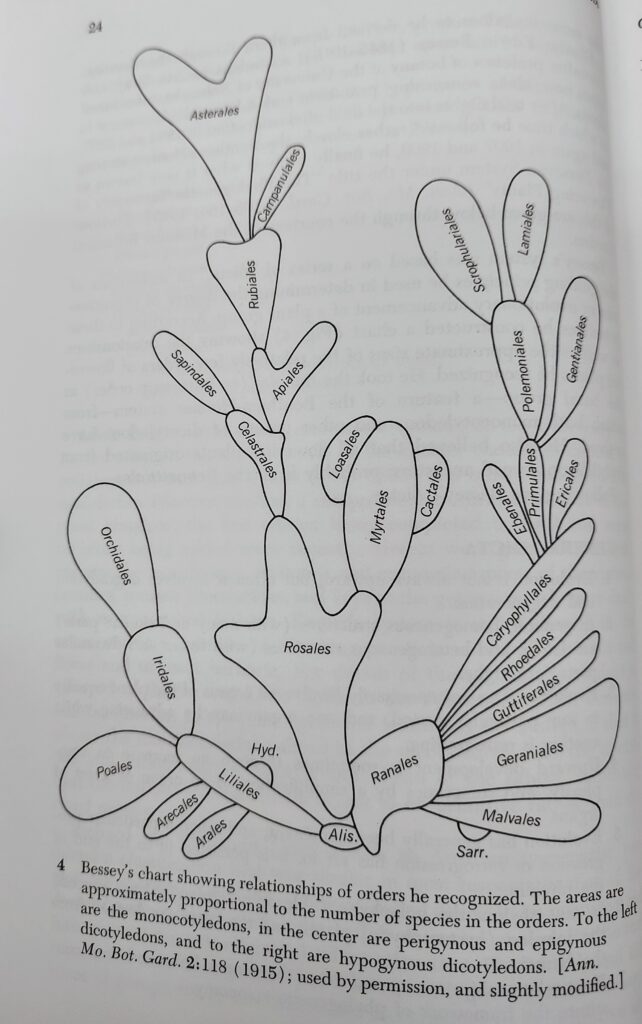
The name Besseya commemorates Charles Bessey (1845-1915) an American botanist from the University of Nebraska who wrote several influential botany textbooks. Bessey is perhaps best known for developing an early classification scheme for angiosperm orders (groups of similar plant families) based on their likely evolutionary history. To this end, Bessey developed a set of guiding principles (or dicta) to differentiate between ancestral characteristics (such as numerous, separate floral parts) and more recently derived traits (like a reduction and fusion of floral parts). Bessey created a simple, but very influential diagram depicting the relationships among orders that resembled the branched arms of a prickly-pear cactus (and became known as “Bessey’s cactus”). While Bessey’s arrangement of orders is no longer accepted based on more recent anatomical and molecular data, many of his dicta are still recognized as useful, and his cactus-like diagrams have been adapted by more other big-picture systematists, such as Arthur Cronquist, and the Angiosperm Phylogeny Group.
In 2004, Larry Hufford (former director of the WSU Ownbey Herbarium) and his then-graduate student Shelley McMahon applied modern phylogenetic methods to Besseya and Synthyris and concluded that the 7 species of Besseya were completely nested within Synthyris and should therefore be transferred to that genus. Another former WSU graduate student, Dirk Albach, and colleagues conducted a similar analysis but including many species of Veronica and found compelling evidence that Synthyris itself is hopelessly embedded within Veronica. So now Wyoming kittentails has yet another new name – Veronica wyomingensis! To complicate things even further, Hufford and McMahon assessed specimens from throughout the Rocky Mountains and found there are two phases of wyomingensis – populations with white anthers and others with blue or purple anthers. Whether these represent distinct taxa remains to be determined. So at least some Wulfenia/Synthyris/ Besseya/Veronica wyomingensis plants may get another name. Again. – Walter Fertig, 19 August 2025