John Leiberg and John Sandberg were Swedish-born botanists hired by the US Department of Agriculture in 1893 to document the flora of the “Plains of the Columbia” in north-central Washington. Although they were not the earliest botanists to explore Washington, Leiberg and Sandberg were the first to record detailed information on climate, soils, and vegetation along their route from Spokane to Stevens Pass. Their data provide a critical baseline for assessing changes in the flora and vegetation of eastern Washington since the 1890s. They noted the arrival of many new weed species, the decline of native grasses and shrubs from overgrazing and conversion of wildlands to farming, and the impacts of wildfire on the dry forests on the east side of the Cascades.
Over 850 specimens from Lieberg and Sandberg’s survey are deposited in the Ownbey Herbarium. Unfortunately, Leiberg’s planned report summarizing their findings was continually postponed during the 1890s and early 1900s and was not finalized when he died in 1911. Washington State University ecologist Richard Mack learned of the manuscript while researching the arrival of cheatgrass (Bromus tectorum) in the Pacific Northwest (first documented by Sandberg and Leiberg in 1893!). With the help of some intrepid librarians, Mack relocated the typed, 122-page draft in the National Archives. Mack summarized the report in his 1988 paper First Comprehensive Botanical Survey of the Columbia Plateau Washington: The Sandberg and Leiberg Expedition of 1893 (Northwest Science 62(3): 118-128).
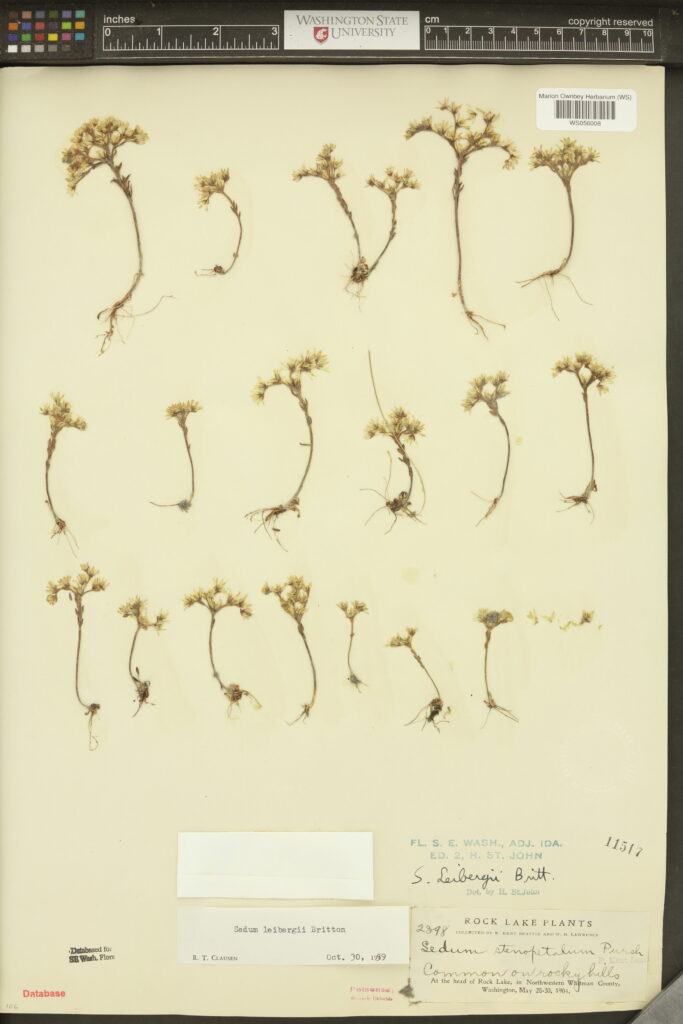
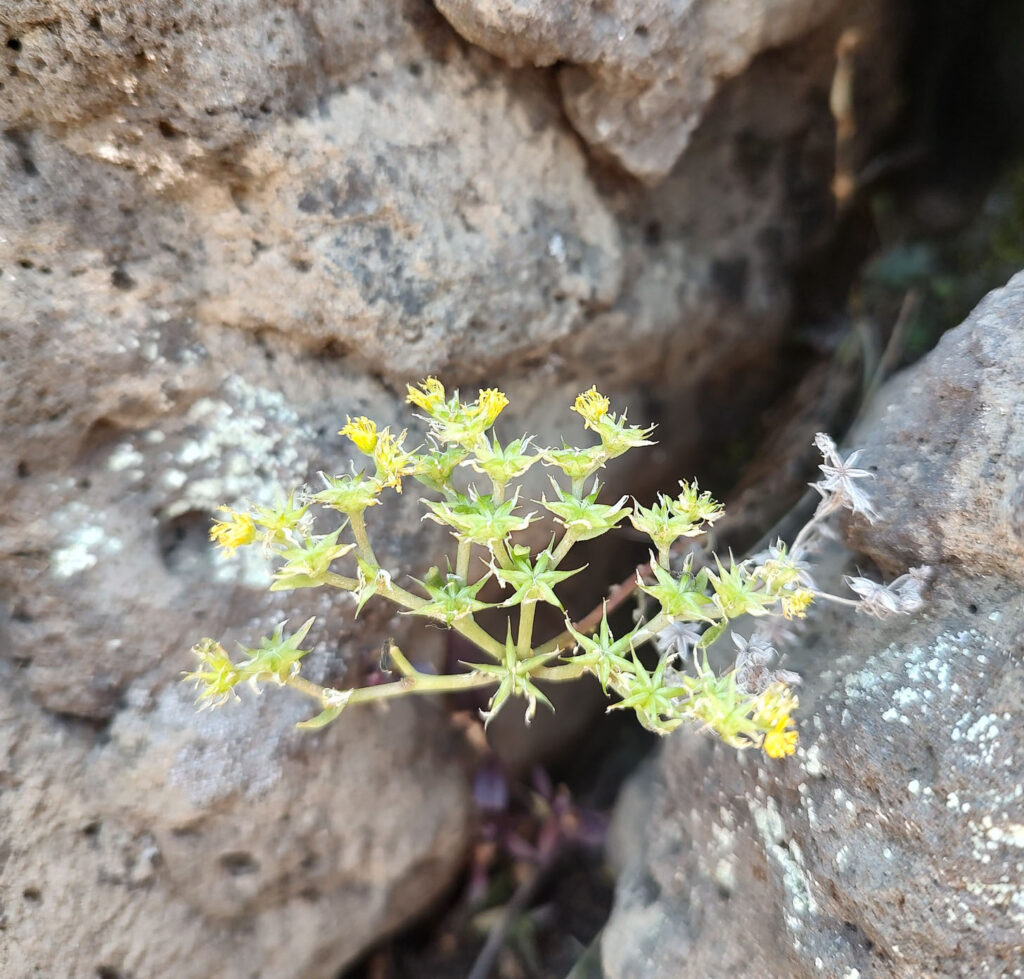
One of Leiberg and Sandberg’s campsites during their 1893 trek was south of Rock Lake, in northwestern Whitman County. Although they apparently missed it, one of the botanical denizens of the basalt cliffs in the area is Sedum leibergii (Leiberg’s stonecrop), a yellow-flowered succulent with a candelabra-like inflorescence, found in volcanic cliffs primarily in the Snake River and lower Columbia River drainage of southeastern Washington, northern Oregon, and west-central Idaho. Several other species were named for the pair, including an Astragalus, Erigeron, and Poa for Leiberg and a Lomatium, Eriogonum, and Poa for Sandberg. The specimen shown here was collected by WSU professor Rolla Kent Beattie in 1904 who, in the spirit of Leiberg and Sandberg, made baseline plant collections and observations of the flora of Rock Lake that inform studies on the changing landscape of the Columbia Plateau today. – Walter Fertig, 5 September 2025