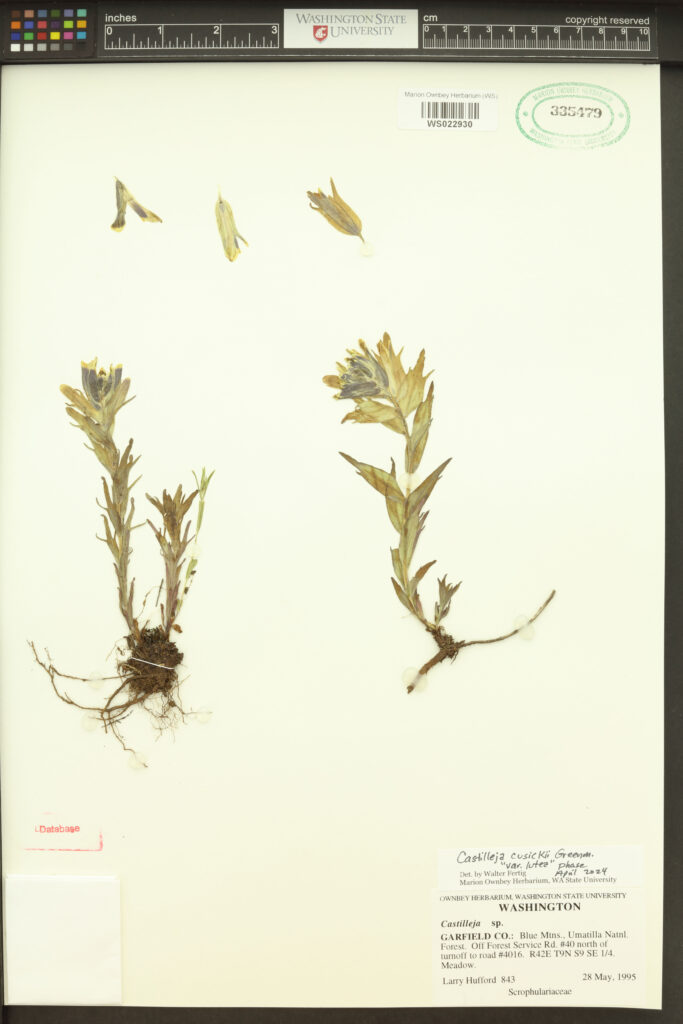
The paintbrushes (genus Castilleja) are a genus of about 200 mostly herbaceous plants, distributed across the Americas and northern Asia. They are, in many respects, annoying. Other plants feel this way because paintbrushes are hemiparasites, which derive part of their nutrition from the roots of their host (hemi- means half), and the remainder by photosynthesis. No plant ever wants to have their stuff stolen, not even part of it! Taxonomists find paintbrushes irritating because their variable morphology, and tendency to hybridize, makes it difficult to delimit species. Horticulturists get frustrated with the paintbrushes’ difficult growing requirements: they must have another plant to survive. However, ecologists enjoy this aspect: when paintbrushes take resources from plants that might otherwise dominate an ecosystem, it can create room for other species to colonize, creating a more diverse community.
Of course, taxonomists love a good challenge. Castilleja cusickii (Cusick’s paintbrush), named for prominent Pacific Northwest botanist William Conklin Cusick (1842-1922), is just one of many active taxonomic headaches among the paintbrushes. This species ranges from eastern Washington south into Nevada and Utah, east to Montana and Wyoming, and north to Alberta and British Columbia. A perennial 8-20 in (~20-51 cm) high, it prefers open areas from low-lying valleys to subalpine meadows. The most visually striking feature of Cusick’s paintbrush are the bright bracts that adorn the long, straight inflorescence. Colorations of yellow, white, and less frequently purple or pink have been observed across the range. Most populations of Cusick’s paintbrush have yellow flowers and bracts. A population around the Idaho-Utah border has unique, mixed pink-purple bracts, but no other detectable differences in morphology. Another variant, on the western edge of the species range, has a wider inflorescence and broader bracts with deep purple veins. These observations, combined with genetic work by David Tank at the University of Wyoming, suggest a possible resurrection of the name C. lutea for the western variant. A comparison of all specimens of C. cusickii from across its range, however, does not reveal as clean a separation as predicted, per Castilleja expert Mark Egger in a recent iNaturalist comment. Separately from these variants, C. cusickii is known to hybridize with C. gracillima in Oregon’s Logan valley, and with C. miniata and C. rhexifolia elsewhere. Break out the ibuprofen, because taxonomic clarity for Cusick’s paintbrush is unlikely to arrive anytime soon. – Henry Landis, 6 November 2025