Back in college as a budding biologist, I remember learning of Jean-Baptiste Lamarck, the late 18th and early 19th century French scientist widely derided for his hypothesis of evolution based on acquired morphological traits (such as a longer neck in giraffes, or beefier biceps in blacksmiths) being passed on to subsequent generations. Lamarck’s ideas were derived before Charles Darwin advocated evolution via natural selection and a century before the rediscovery of Gregor Mendel’s classic studies on genetic inheritance in peas. We tend to overlook Lamarck’s insights on the veracity of biological evolution while mocking his error in the mechanism, which always struck me as a little unfair. Improvement or rejection of hypotheses in light of new data is the foundation of the scientific method and should not negate the body of scholarly work by people like Lamarck, even when they are wrong in hindsight.
Recent discoveries in the field of epigenetics provide a small bit of vindication for Lamarck. Cell biologists have discovered that some changes in the chemical structure of DNA, such as the addition of a methyl group, or change in histone proteins, can be passed on to future generations. Evidence for this comes from survivors of famine in World War II who later gave birth to children more prone to adult obesity as a result of malnutrition in their maternal relatives. While natural selection is still the driver of the vast majority of evolution, these epigenetic changes provide another avenue for modification of DNA in inheritance. Of course, Lamarck did not foresee any of this, but perhaps his mistaken hypothesis of evolution was not entirely off base, as we all learned in school.
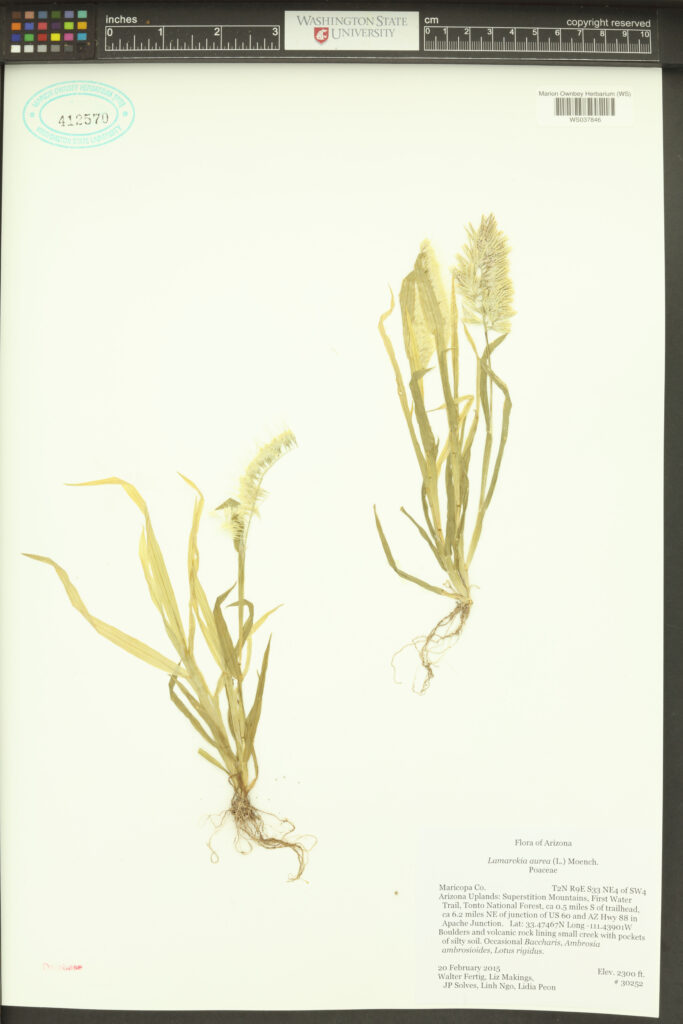
Lamarck made several important contributions to biology, which unfortunately have been overshadowed. In 1778, he published a three-volume flora of France. He later shifted his attention to invertebrates and published an early taxonomic treatment of this part of the animal kingdom. In recognition of his many accomplishments, the monotypic Mediterranean grass genus, Lamarckia was named in his honor by German botanist Conrad Moench. Lamarckia, commonly known as goldentop grass or toothbrush grass, has clustered spikelets of yellow florets with elongated lemma awns, giving the inflorescence the appearance of a yellow, frayed, dental instrument. It has become widely established in northern Mexico, Arizona, and California and may be moving northward, as it adapts to warming climates. – Walter Fertig 6 May 2026