Xerpha Gaines (1891-1970) was a prominent Washington State University alum and botanist, with particular expertise in weeds. Born in Wisconsin and moving to Washington with her family in the early 1900s, she was an exceptional student with an intimate familiarity of the local flora. She married WSU agronomist Edward Gaines, who encouraged her to pursue a botany degree at WSU. After Edward’s death in 1944, Xerpha took an assistant curator position at the Marion Ownbey Herbarium, often making collection rounds in Pullman and nearby Moscow. She engaged in a seven-year collaboration with USDA surveyor Theo Sheffer to conduct a botanical survey of the Grand Coulee, a riverbed in central Washington. Later, she joined collecting trips to the Glen Canyon region in Utah and Arizona, and bolstered her reputation as an expert in plant identification, especially in picking out weeds from among seed or leaf vouchers. At the time of Xerpha’s death, she was working on Weeds of Eastern Washington, a comprehensive guide to weed identification and management for the region. Her influence on botany in WSU and the broader Pacific Northwest, through her publications and thousands of collections in the herbarium, remains extensive to the present day.
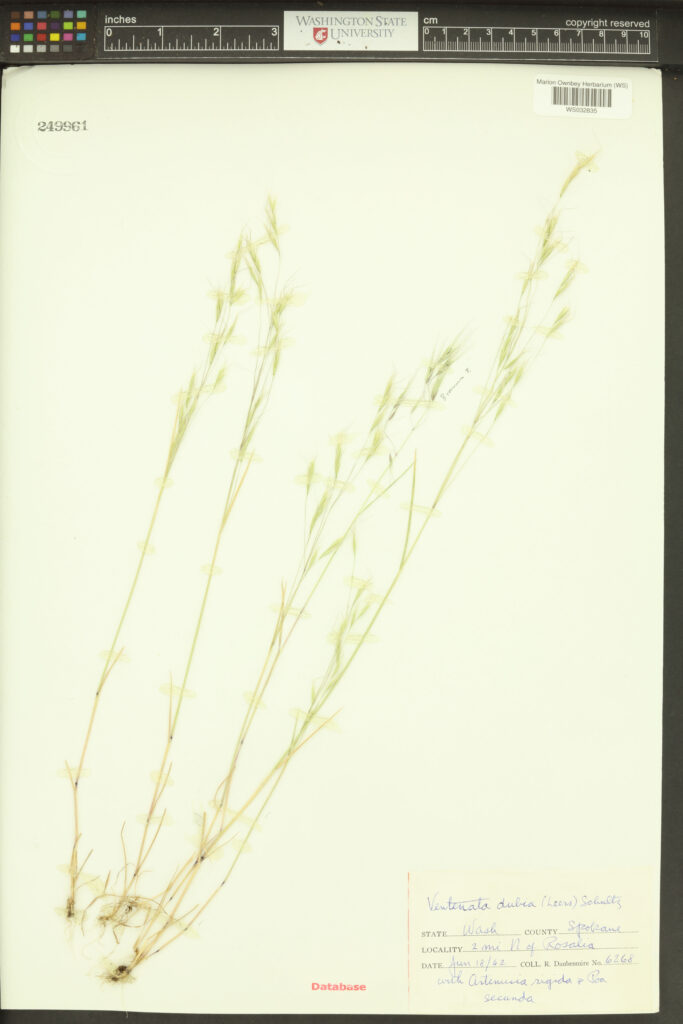
Xerpha could identify weed species in Washington decades before most other experts recognized them as a threat. A notable example is wiregrass (Ventenata dubia), native to southern Europe and northern Africa, but increasingly widespread and problematic in the Pacific Northwest. It is a tufted annual grass with slim, upright stems covered in small hairs. The leaves occur mainly on the lower half of the stem, smooth on the upper surface and rough underneath, with blades that start out flat but slowly roll or curve inward. The inflorescence is a yellow-brown panicle with awns on the upper florets that are sharply twisted or bent. The awn shape distinguishes wiregrass from cheatgrass (Bromus tectorum), which has straight awns. Wiregrass inhabits a variety of environment types, with a preference for disturbed spaces. Wiregrass infests croplands and reduces yields, the bent awns can jam mechanical equipment, and grazing animals don’t like it. Much of its spread comes from intermixing with grass crops like wheat or alfalfa, causing farmers to inadvertently plant the seeds. On top of that, wiregrass seeds can be dormant for 3-4 years, meaning that any eradication effort must account for that timeframe. Some herbicides are known to be effective, but since wiregrass prefers disturbed areas, the ideal solution is likely to promote healthy plant communities. If conditions are stable and competition from native plants is high, that limits the opportunity for wiregrass to get in. What counts as a healthy community can vary across environments, of course; for the Palouse, we can thank Xerpha Gaines for quite a bit of what we know and what we need to defend against. – Henry Landis, 4 June 2026