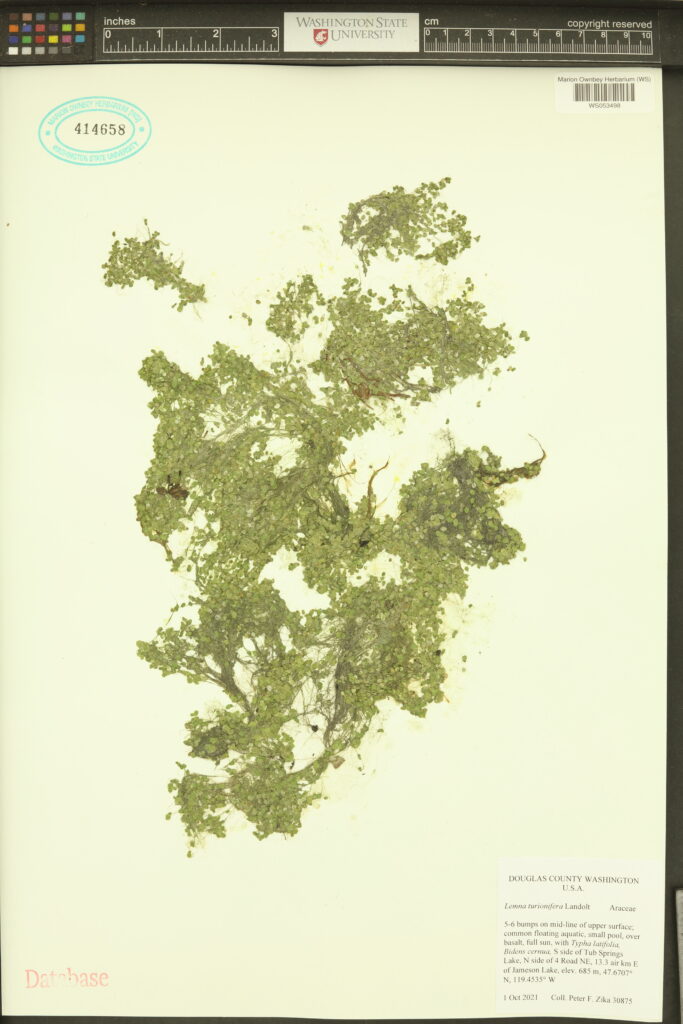
Duckweeds (genus Lemna) are common inhabitants of slow-moving surface waters of lakes and ponds around the globe. At first glance, they might be mistaken for mats of algae or fragments of grass or sedge leaves left behind by a sloppily-feeding muskrat. Individual duckweed plants consist of a single, flat thallus (technically a modified leaf-like stem) 1/8 to ¼ of an inch long with a slender strand of vascular tissue. Although they are rarely seen (even under a microscope), duckweeds also produce tiny flowers. The duckweed inflorescence consists of two minuscule pollen-bearing staminate flowers and one tiny, seed-producing pistillate flower in a pouch-like sac. Taxonomists postulate that the duckweed inflorescence is akin to the large, leafy spathe and club-like spadix of skunk cabbages, Jack-in-the-pulpit, calla lilies, and other members of the Arum family (Araceae)! Despite their tiny size, duckweed flowers can attract pollinators like flies, mites, and small bees with sticky secretions from the stigma. Duckweeds can also be “contact pollinated” through the collision of adjacent floating stems that jars pollen loose and on to the receptive stigma.
Sexual reproduction is probably the exception rather than the rule in duckweeds. More often, species propagate asexually by forming chains of new stems from vegetative buds. Turion duckweed (Lemna turionifera) can also produce specialized buds called turions that break off the parental stem and sink to the bottom of a lake or pond to over-winter. In spring, the starch-filled turions rapidly begin to metabolize, causing the structure to float back to the surface and grow into a typical duckweed stem.
Duckweeds grow quickly and produce new offshoots rapidly. Dense populations are an important food source for aquatic waterfowl and fish, but can become a nuisance to humans. Scientists have recently come to appreciate the fast growth rate of duckweeds, however, and the plants are being used for bioremediation of waterways with excessive amounts of phosphorus and nitrogen from agricultural runoff. Harvesting duckweeds as a crop can remove these pollutants and provide valuable livestock feed or fertilizer. Researchers are also developing techniques to use genetically modified duckweeds to synthesize insulin and other commercially valuable proteins (being plants, duckweeds are immune to animal viruses, making them invaluable in creating new biomedicines) – Walter Fertig 25 June 2026