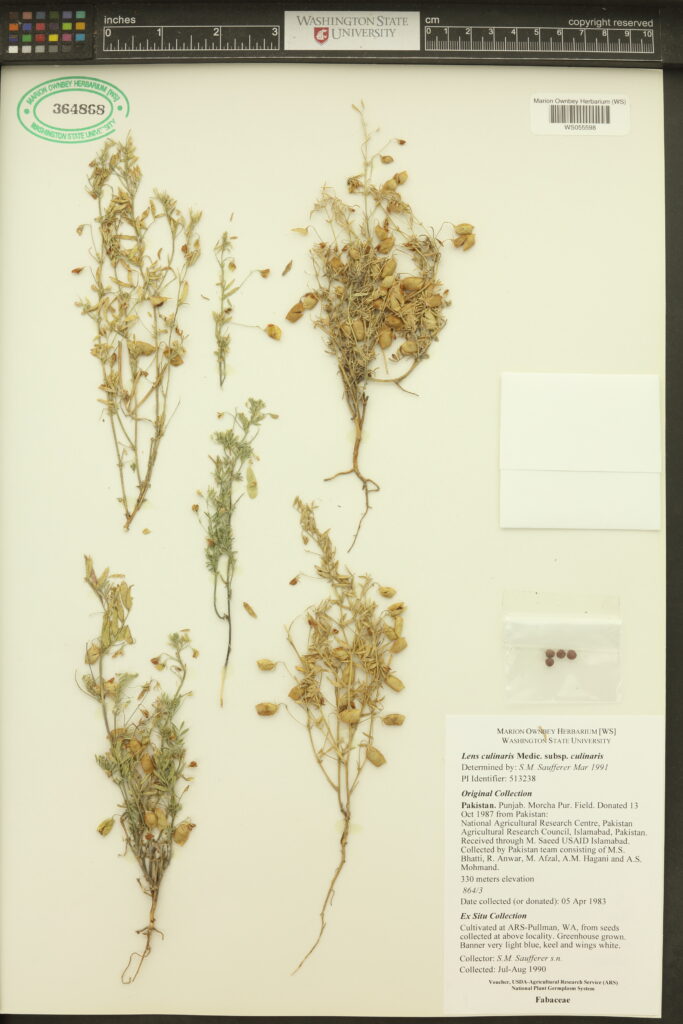
Lentils are unassuming annual plants, with slender stems 6-20 inches tall, pinnately compound leaves, and small clusters of ½ inch long white, pink, or purplish pea-shaped flowers. The fruit pods contain just 1 or 2 round, lens-shaped seeds that resemble tiny monocles. Humans have been cultivating lentils for over 10,000 years, making this legume one of the world’s oldest agricultural crops. Lentils are believed to have originated in the Middle East and then spread across the Mediterranean and the Indian subcontinent (where lentils play a central role in the local cuisine). Being high in protein, iron, and vitamins A & B, lentils are a healthy and inexpensive alternative to meat.
Although first introduced to North America by the Spanish in the 1500s, lentils were not widely cultivated in the US until the early 20th Century. Lentils were first grown in the Palouse grasslands of SE Washington in 1916 and initially marketed to religious vegetarians. Lentil farming accelerated during World War II as consumers sought other protein sources when meat was rationed for the war effort. The rich, loess soils, dry summers, and cool, moist winters of the Palouse proved ideal for lentil cultivation, often in rotation with wheat. By the mid to late 1900s the Palouse region was the largest producer of lentils in the United States (that title has since passed to Montana). In 1989, Pullman (home of Washington State University and the Ownbey Herbarium) proclaimed itself the “Lentil Capital of the World” (though Australia is technically the leading producer) and inaugurated an annual Lentil Festival on the weekend before fall semester begins. In addition to a parade (featuring official mascot, Tase T. Lentil), live music, and educational displays, the festival features the world’s largest vat of lentil chili (with free samples for one and all). The festival is easily the largest pulse-themed social event in eastern Washington.
Linnaeus, the original chronicler of all known plant names, included lentils in the first edition of his Species Plantarum in 1753 under the name Ervum lens. The species was later renamed Lens culinaris (“kitchen lentil”) by Friedrich Medikus in 1787 and again transferred to the vetch genus (as Vicia lens) in 1845. Recent molecular research suggests that Lens is nested within Vicia, though experts remain divided on how to treat the genus. In the meantime, Pullman civic boosters have no intention of renaming their celebration the “National Vetch Festival”. – © Walter Fertig 11 August 2026