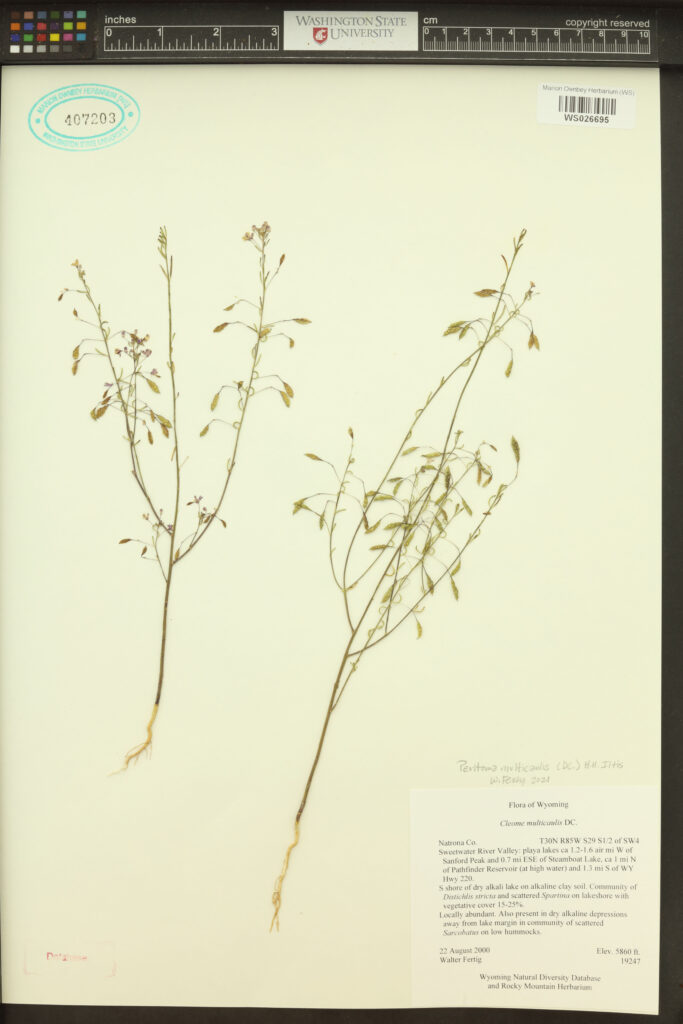
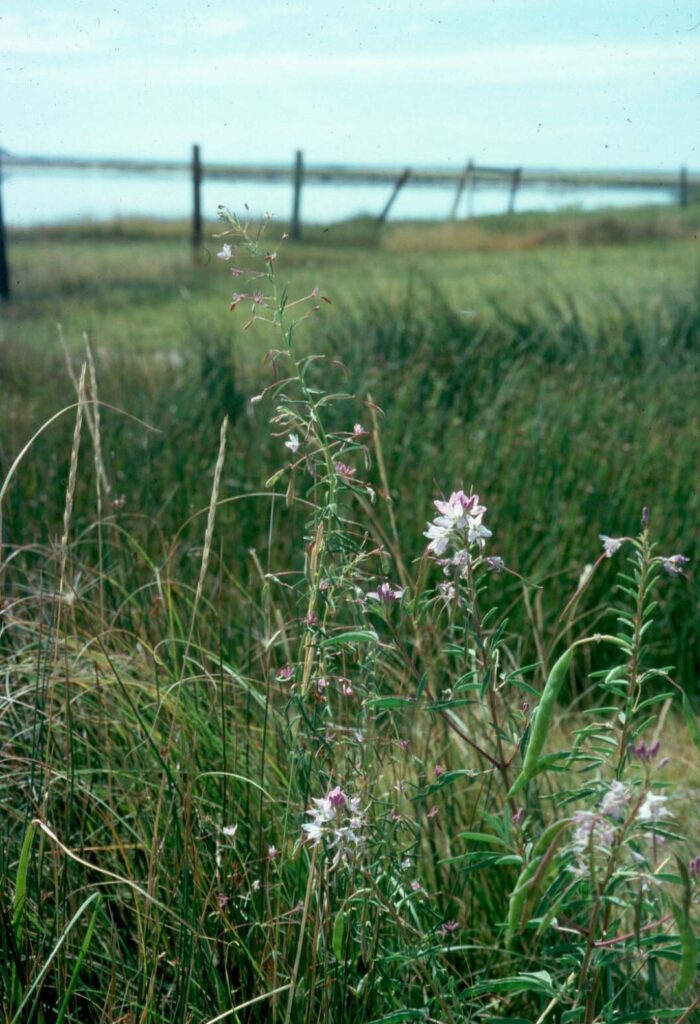
Slender spiderflower is a skinny annual herb in the Cleomaceae (spiderflower family) with pink, 4-petaled flowers and stalkless leaves divided into 3 narrow leaflets. It occurs widely from central Wyoming to central Mexico, where it is restricted to semi-barren alkali-rich and saline soils surrounding playa ponds and old lake beds. These sites are often dominated by salt-hardy graminoids, including saltgrass (Distichlis spicata), Baltic rush (Juncus balticus), and seaside arrowgrass (Triglochin maritimum), as well as billions of biting horseflies!
Despite its large geographic range, individual populations of Slender spiderflower are often isolated from each other by hundreds of miles, and the species is considered rare in most of the states in the southwestern US where it occurs. Disjunct populations, like these, can occur naturally through the contraction of a once more continuous range (called vicariance by biogeographers) or by rare, long-distance dispersal events (often facilitated by waterfowl with muddy, seed-encrusted feet). Humans can also enable dispersal through purposeful or inadvertent means. William Weber, a WSU graduate student in the 1940s and expert on the flora of Colorado, suggested that populations in his state were derived by Spaniards bringing seed to the San Luis Valley from Mexico during the Colonial era.
For conservation biologists, the origin of disjunct populations is important for setting conservation priorities. Isolated populations are of keen interest as they may become genetically distinct through founder effects or genetic drift – but only if the species arrived by their own means. Determining nativity of disjunct populations might be determined by genetic tests, or by assessing herbarium records to determine when populations were first documented.
The Wyoming population, shown here, is the only one known from the Cowboy State and is 320 miles (515 km) north of the nearest occurrence in southern Colorado. It was thought to have been first discovered in Wyoming in 1980 along alkali ponds at Pathfinder National Wildlife Refuge near the (now inundated) confluence of the Sweetwater and North Platte rivers. Hugh Iltis in his 1952 doctoral dissertation on Cleome noted that Alexander Gordon collected a specimen of C. multicaulis from “Platte River” in 1843. Gordon was one of four botanists traveling with Scottish adventurer Sir William Drummond Stewart on a “pleasure excursion” up the Platte River of Wyoming and on to South Pass, which would have taken the travelers right through this population (this is the same route that became the Oregon Trail for half a million emigrants, starting after the 1849 California gold rush). While this discovery cannot completely disprove the human-introduction hypothesis, it does demonstrate that this species is not a recent arrival in Wyoming.
Cleome multicaulis has changed names twice in the past 20 years. In 2007, Hugh Iltis transferred it to the genus Peritoma for the Flora of North America. Just eight years later, Ownbey Herbarium director Eric Roalson and colleagues subsumed Peritoma and several other genera into the genus Cleomella based on modern molecular data. Similar studies have shown that Cleomella and friends also belong in their own family (Cleomaceae), separate from the tropical shrubs and trees of the Caper family (Capparaceae) where they were traditionally classified. © Walter Fertig 25 August 2026