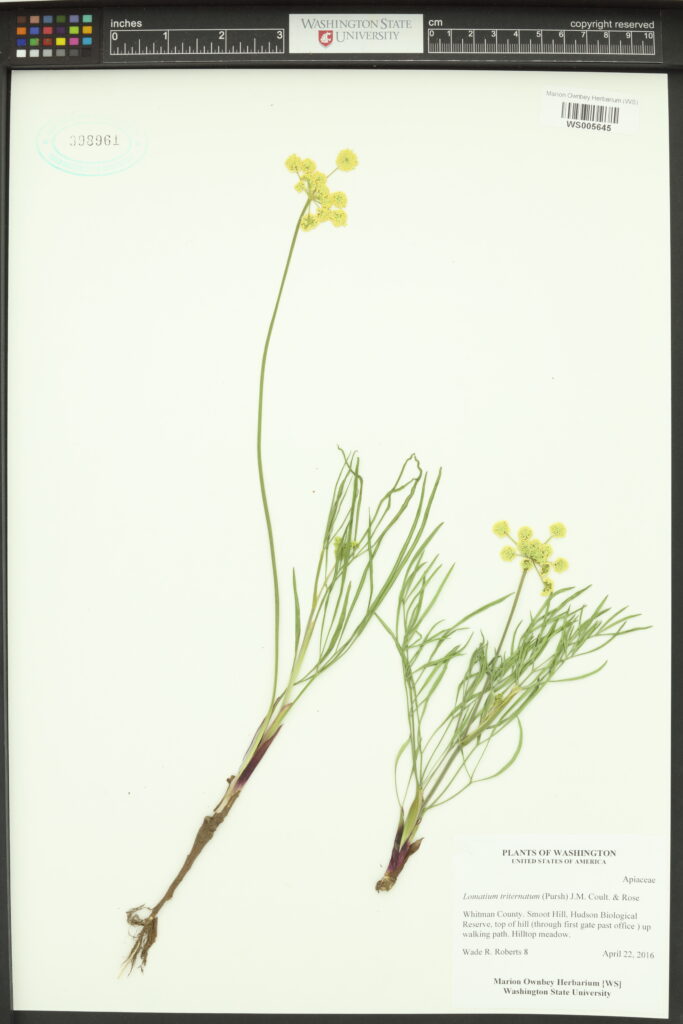
Washington State has over 40 species of biscuitroot (Lomatium) – and counting, as taxonomists continue to discover new, highly localized species, often from unusual soil types or isolated mountain peaks. In some cases, however, new species are being recognized within existing, widespread and previously polymorphic species. A good example is nineleaf biscuitroot (L. triternatum) which has been found to consist of at least 5 species in Washington and Oregon, each differing in the proportions of their leaflets and features of their mature fruits. Several are narrow endemics, but L. triternatum is still quite common and widespread in dry, rocky grassland and sagebrush habitats from southwestern Canada to eastern Oregon, Idaho, and Wyoming.
As their common name implies, biscuitroots have starch-rich, edible roots and were an important food source for indigenous cultures in the western United States. Several species may co-occur in the same site and appear to partition their habitat by flowering at different times of the early spring or summer.
Nineleaf biscuitroot (named for what appear to be nine leaves at each node, but which are actually 3 sets of narrowly three-forked leaflets) is locally abundant on the summit of Smoot Hill, a prominent glacial loess feature located about 12 miles northwest of Pullman. The 800 acre site has been owned by Washington State University since 1968 to preserve its remnant Palouse Prairie grasslands and Ponderosa pine forests. Although once farmed, the summit is now dense with biscuitroots and other perennial wildflowers that are otherwise uncommon in the agricultural landscape of SE Washington.
This specimen was collected in 2016 by WSU student Wade Roberts, who along with fellow biology undergrads Lucy Allison and Joseph Kleinkopf conducted a two-year floristic survey of Smoot Hill (technically the George Hudson Preserve, for the WSU professor who spearheaded the protection of the site). The students documented 260 species of vascular plants from the preserve, all with vouchers housed in the Ownbey Herbarium.
Unfortunately, in late August 2026 a human-caused wildfire scorched the upper summit of Smoot Hill, including a dense bed of Nineleaf biscuitroot. The biscuitroots and other native wildflowers were largely dormant at the time, and most have deep underground roots or a seed bank. It is hoped that the site will recover quickly next spring, augmented by winter snow and a new layer of fertilizing ash (although invasive annual weed seeds are also likely to germinate). Researchers at WSU and other universities are already planning studies to document the recovery of the site, and the floristic checklist prepared by the WSU students ten years ago will be an invaluable reference for comparing potential changes in the flora. – © Walter Fertig 14 September 2026