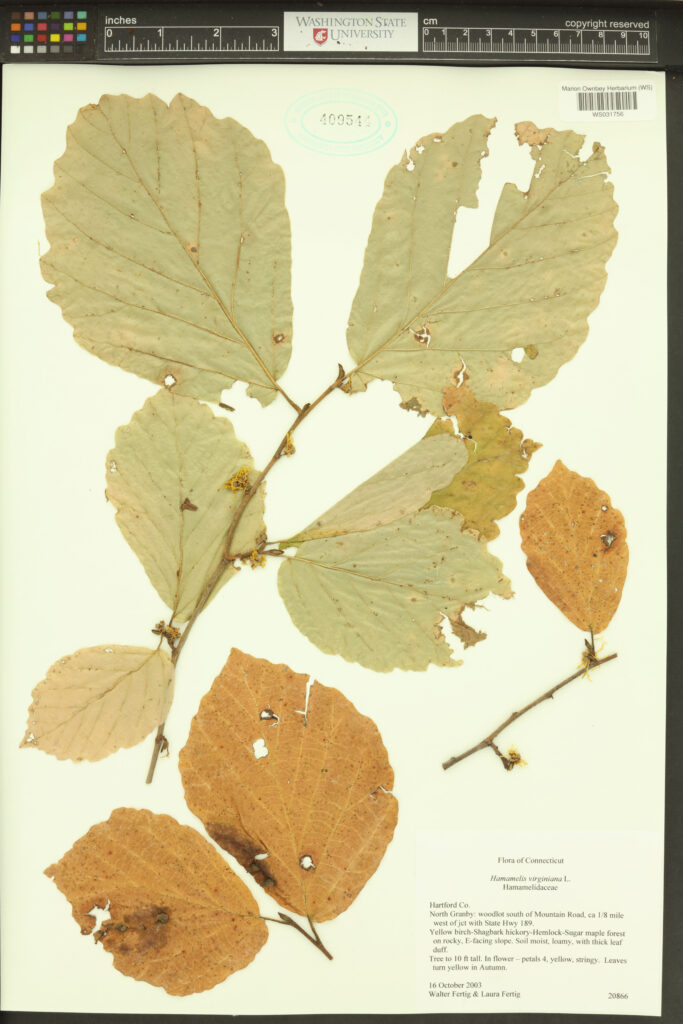
For most of the year, witch hazel (Hamamelis virginiana) is a rather nondescript understory shrub or small tree in the wetter forested areas of eastern North America. Come Autumn, however, it takes center stage. First, its oval, wavy-margined leaves change color from dull green to bright yellow as the plant removes chlorophyll from its leaves in anticipation of shedding them over the winter. Second, just as it starts losing leaves, witch hazel unfurls its small, mildly spicy or lemon-scented, stringy, 4-petaled yellow flowers. Since no other trees are blooming at this time of year, witch hazel has its pick of the last pollinating insects of the year. Finally, witch hazel seeds are released in the fall when the woody, 2-beaked fruit capsule dries out and forcibly shoots one or two seeds up to 30 feet from the parent tree, often with an audible pop!
Witch hazel has long been known as a medicinal plant. Indigenous cultures used it to treat skin and eyes, and as a tea for various ailments. Water of witch hazel, derived from its bark and leaves, is still used in commercial cosmetics, mouth wash, eye lotions, soap, and various ointments.
One of the more famous (or infamous) uses of witch hazel was for divining water. Practitioners (often called dowsers) favored Y-shaped witch hazel branches that they would employ to locate underground sources of water for drilling a well or irrigation. The dowsing rod responds to hidden water (or other buried treasure, such as gold or missing car keys) by dipping downward. Unfortunately, science has been unable to replicate the performance of water witching, and some researchers attribute the phenomenon to the ideomotor effect resulting from unconscious, involuntary physical movement (kind of like a Y-shaped Ouija Board).
The “witch” in the name witch hazel also suggests the occult, but it is actually derived from the Middle English word wiche, meaning pliant, or bendable (like the witching rod). But given how witch hazel really comes into its own in the Autumn, a reference to Halloween may not be so far-fetched. – © Walter Fertig 30 September 2026