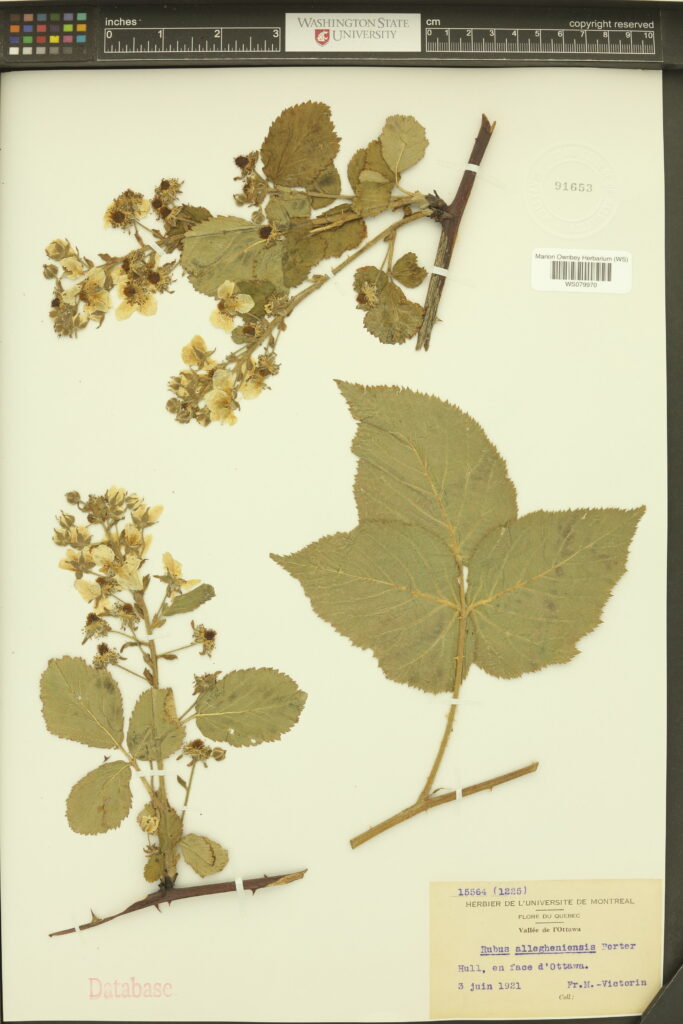
Common or Allegheny blackberry (Rubus allegheniensis) is one of the most widespread and common brambles in eastern North America and has escaped cultivation along the west coast from British Columbia to California. It can be recognized by its erect to arching stems covered with stout prickles, palmately compound leaves of 5 toothed leaflets, and racemes of white flowers with glandular stalks. As the common name implies, the fruits are black at maturity. As we all recall from General Botany, Rubus have “aggregate” fruits comprised of numerous, small, fleshy, 1-seeded drupelets that are all shed together. In true blackberries (which are not always black!) the drupelets remain attached to a fleshy receptacle (the original base of the flower from which the fruit is derived) as opposed to raspberries, in which the fruits slip off the receptacle and appear hollowed, like a thimble. Common blackberry is edible and readily consumed by bears, foxes, raccoons, mice, songbirds, quail, and humans.
Defining species of Rubus is one of the thorniest problems in taxonomy. Many differences in stem and leaf traits are related to environmental factors or growing conditions. Blackberries and raspberries also frequently hybridize, are often polyploid (with 4-7 duplicate sets of chromosomes), and can reproduce asexually by vegetative means or apomictic fruits. Minor variation from mutation or hybridization can persist in local populations for generations. In the past Rubus enthusiasts have recognized hundreds of species differing in very subtle ways. More recently, the trend has been to lump these “microspecies” into fewer but more variable diploid species, while acknowledging many individuals are likely to be hybrids or polyploids. As a result, more than two dozen formerly recognized species are now lumped under R. allegheniensis. But fear not splitters – modern genetic methods are suggesting many of these subsumed taxa may turn out to be legitimate after all.
The specimen shown here was collected by French Canadian botanist Fr. Marie-Victorin, who is best known as the author of the first comprehensive flora of the St. Lawrence River area of southern Quebec. Born Conrad Kirouac (beat writer Jack Keroauc was a cousin), Victorin adopted his new name when ordained in the Catholic religious order the Brothers of the Christian Schools. He was a self-taught botanist and later became the chair of Botany at the University of Montreal and helped establish the university’s botanic garden. Victorin named 188 new vascular plant taxa, mostly from Quebec, and often based on relatively minor differences (such as flower color). Relatively few of his species and forms are still recognized.
Victorin died in an automobile accident in 1944, but is still remembered in popular culture today. He is featured prominently in two recent French-Canadian films – one a comedy (Les Les fleurs oubilées or “Forgotten Flowers” from 2019) and the other a period drama (Dis-moi pourquoi ces choses sont si belles or “Tell me why these things are so beautiful” from 2023). In the comedy, Victorin is bored in Heaven and returns to Earth to help a disgruntled, reclusive agronomist take down an evil, polluting corporation. – © Walter Fertig 18 October 2026