Researchers at WSU received an award from the National Science Foundation to support the new Robustness and Resilience of Aquatic Biological Systems Research Experience for Undergraduates (R&R REU Program). Biological systems in our oceans, lakes, and streams are under extreme pressure of environmental change, and scientists aim to understand the complex mechanisms that allow these systems to either maintain robustness and resilience to these pressures or collapse. The primary objective of the R&R REU Program is to expand students’ understanding of robustness and resilience of biological systems by engaging them in research projects that investigate how genomic, cellular, physiological, behavioral and ecological systems of aquatic plants and animals respond to environmental challenges. The R&R REU Program will take place primarily on the Pullman Campus, although some mentors will be from the Vancouver Campus; the Program will be administered by the Principle Investigator, Dr. Erica Crespi, Director of the Aquatics Phenomics Research Center. The R&R REU Program will support the training of 10 students for 10 weeks during each of the summers between 2025-2027. It is anticipated that a total of 30 students, primarily from schools with limited research opportunities or from under-represented groups. Students will learn how research is conducted in this field, present their research at a campus-wide REU Summer Symposium, and many will present the results of their work at scientific conferences and in scientific publications.
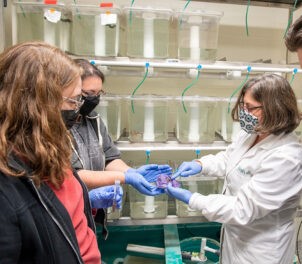
The R&R REU Program will bring together an interdisciplinary team of investigators from the School of Biological Sciences, School of the Environment, Animal Sciences, and the College of Veterinary Medicine that study aquatic biological systems at different levels of organization. These investigators will mentor undergraduates undertaking projects that ask questions within the field of systems biology, with access to high-throughput phenomics equipment to study physiology and behavior of organisms under different environmental stressors. Students will engage in Systems Thinking and Data Wrangling workshops, including Indigenous knowledge and western science approaches, and reading groups focused on multi-scale analysis of biological systems. Students will also receive training on research code of conduct, scientific literacy, collaboration, science communication, and professional development. Students will be introduced to scientists from academia, industry, government agencies, non-profit organizations, and tribes in a seminar series to broaden their professional networks and exposure to diverse career pathways in STEM fields.
For more information, go to the R&R REU Program website.